

The year 2026 marks a historic turning point for Indian education. We are moving past the era of "emergency digitization" and "experimental gadgets." Today, the National Education Policy (NEP) 2020 has matured from a visionary document into a strict operational mandate for schools and universities across the country.
For school owners, university trustees, and principals, the pressure to deliver measurable learning outcomes through technology has never been higher. Choosing the right edtech company in this landscape is no longer a simple procurement task. It is a high-stakes strategic decision. The partner you choose today will determine your institution's National Assessment and Accreditation Council (NAAC) grading, your National Institutional Ranking Framework (NIRF) standing, and, most importantly, the career readiness of your students.
In this guide, we explore how to navigate the crowded market of edtech companies to find a partner that offers sustainable, scalable, and policy-aligned smart classroom solutions.
The Evolution: From Buying Gadgets to Strategic Ecosystems
In the early 2020s, many institutions fell into the "Hardware Trap." They purchased individual pieces of smart classroom equipment without a unifying strategy. By 2026, these fragmented systems will have become "digital white elephants"—expensive, underutilized, and difficult for IT teams to maintain.
The modern institutional leader knows that a digital classroom is not a collection of hardware. It is an integrated ecosystem. Thus, the focus has shifted and evolved as follows:
- The Commodity Era (2020-2023): Focused on screen size, touch sensitivity, and lowest bid price.
- The Integration Era (2024-2025): Focused on software compatibility and cloud storage.
- The Strategic Era (2026+): Focused on AI-driven insights, pedagogical alignment, and long-term partnership ROI.
When evaluating an edtech company, your first question should be: How does your ecosystem simplify my teacher's day and improve my student's grade?
The Shift from Digital Tools to Strategic Education Partnerships
In 2026, the complexity of educational requirements, ranging from hybrid learning models to real-time assessment data, means that a "vendor" relationship is no longer sufficient. You need an edtech company that acts as a strategic partner.
A vendor sells you a product and disappears. A strategic partner (like Roombr) stays to ensure the technology is adopted, the teachers are trained, and the system evolves as new AI capabilities emerge. This shift is driven by the realization that technology is only 20% of the transformation. The remaining 80% is about people, processes, and policy.
Institutions are now looking for partners who can help them with:
- Curriculum Mapping: Ensuring the digital tools actually help teach the syllabus
- Change Management: Helping teachers overcome "tech-phobia"
- Data Strategy: Using classroom analytics to improve institutional rankings
Why an EdTech Company Must Be a Long-Term Partner
Choosing an edtech company is a marriage, not a transaction. Here is why the "Long-Term Partner" model is the only viable path for 2026 and beyond:
Building 21st-Century Skills
The job market in 2026 demands more than rote memorization. Students need digital literacy, financial intelligence, and collaborative problem-solving skills. A long-term partner doesn't just provide a display. They provide the tools, such as virtual labs and global collaboration platforms, that make these skills part of the daily curriculum.
Involvement of PSUs, Government Bodies, and NGOs
Education in India is increasingly a multi-stakeholder endeavor. With massive initiatives like the NIPUN Bharat Mission and increased CSR involvement from Public Sector Undertakings (PSUs) and foundations, your smart classroom must be compatible with national data standards. A strategic partner understands these policy frameworks and helps your institution stay eligible for government grants and NGO-backed funding.
The Academic Bank of Credits (ABC)
Under NEP 2020, students now have an Academic Bank of Credits. This requires institutions to maintain meticulous digital records of student participation and performance. A partner-led digital classroom automatically captures this data, ensuring your institution is always "audit-ready" without adding administrative burden to your faculty.
What to Look for in an EdTech Company Before You Commit
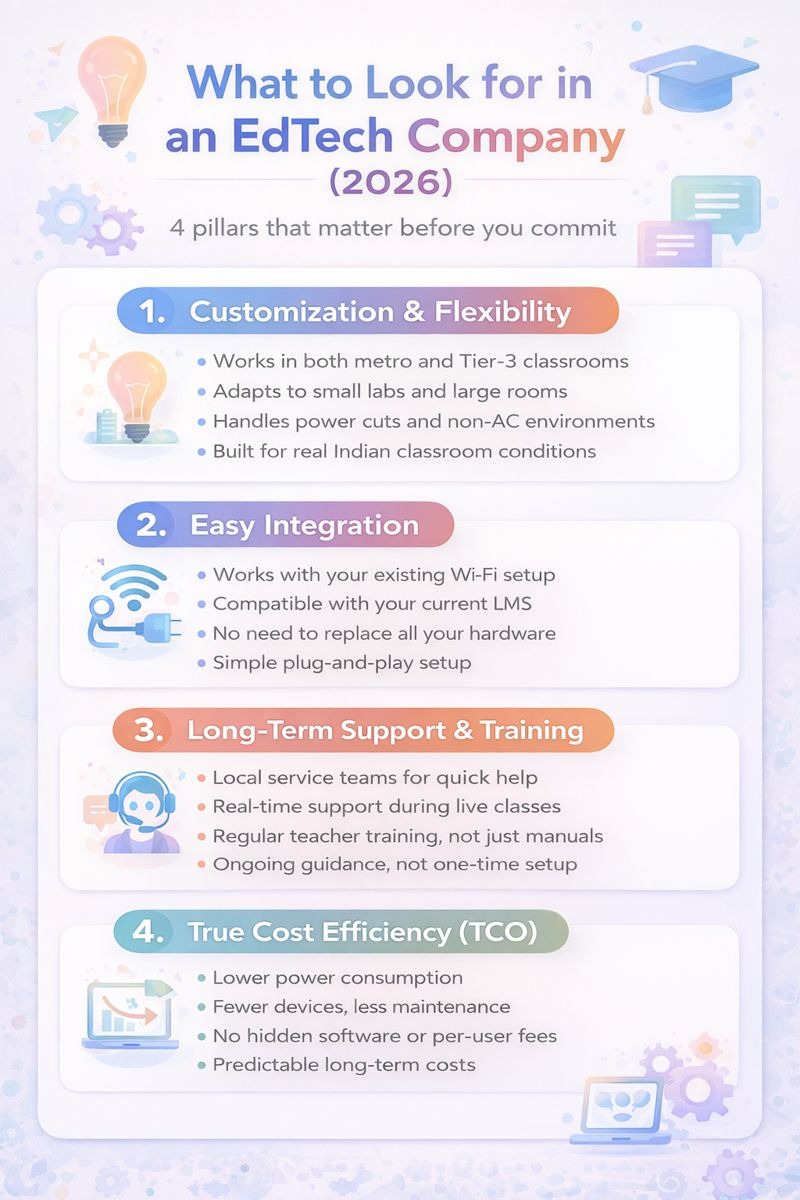
Before signing a multi-year contract, use these four pillars to evaluate the long-term viability of potential edtech companies.
Pillar 1: Customization and Flexibility
India is not a monolith. A classroom in a Tier-3 city has different infrastructure needs than a private international school in a metro.
- Does the solution scale? Can it turn a small 20-student lab into an interactive space?
- Is it "Real India" ready? Does it work in non-AC environments? Does it handle power fluctuations gracefully?
Pillar 2: Integration with Existing Infrastructure
You likely already have some technology. A good partner doesn't demand a "rip and replace." They offer smart classroom equipment that integrates with your current Wi-Fi, supports your existing Learning Management System (LMS), and runs on familiar operating systems.
Pillar 3: Long-Term Support and Training
Technology is only as good as the teacher using it. In 2026, "Email Support" is a failure. If a teacher's screen goes blank during a live session, they need a solution immediately.
- Look for companies with a local service presence in your region.
- Prioritize partners who offer quarterly pedagogical workshops, not just "how to turn it on" videos.
Pillar 4: Cost Efficiency and Total Cost of Ownership (TCO)
In 2026, the smartest institutions look at TCO, not just the purchase price. A "cheap" piece of equipment often comes with massive hidden costs:
- Electricity & UPS Infrastructure: Large, power-heavy panels often require upgrading the school's entire electrical wiring and purchasing expensive industrial-grade UPS systems. Integrated, energy-efficient solutions like Roombr are designed to run on standard school power setups, saving high operational costs over time.
- Maintenance of Multiple Devices: If you buy a separate PC, projector, and camera, you pay for three different AMC (Annual Maintenance Contract) fees. An all-in-one system reduces this to a single point of contact.
- Software Licensing: Some companies charge hidden "per-student" or "per-teacher" annual fees. A true partner provides transparent, flat-rate licensing that includes future updates.
Technology That Aligns With Institutional Goals
Your digital classroom should be a tool for institutional growth. The right edtech company helps you align technology with three critical goals:
NEP-Aligned Learning Models
NEP 2020 emphasizes "Experiential Learning" and "Multilingualism." Look for partners whose software allows teachers to toggle between English and regional languages effortlessly and provides 3D content libraries that make abstract concepts (like molecular biology or geometry) come alive.
Hybrid and Blended Education
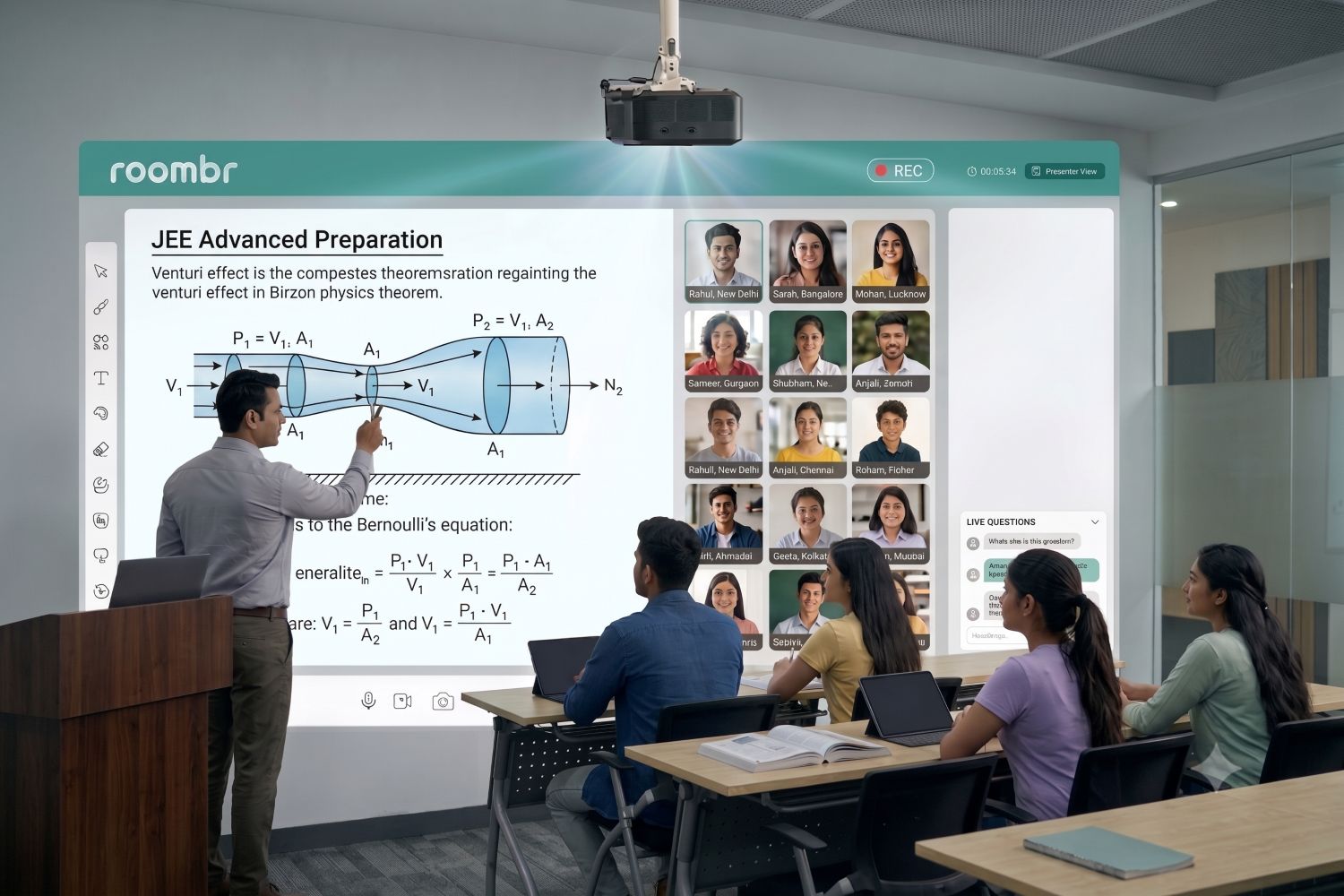
In 2026, learning doesn't stop when the school bell rings. Your smart classroom solutions must include native "Lesson Capture." This isn't just a basic recording. It’s a searchable digital repository. If a student misses a class or wants to revise, they should be able to search for a specific keyword and jump to that exact moment in the recorded lecture.
Scalable Digital Infrastructure
If your institution grows from one branch to five, your technology must be centrally manageable. A strategic edtech company provides a "Command Center" dashboard where the management can monitor usage across all rooms, ensuring that the investment is actually being used by the faculty.
Common Mistakes When Selecting an EdTech Company
Institutional leaders often fall into these three traps:
- Choosing Hardware Over Strategy: Buying a "cheap" interactive board from a vendor who has no educational background. When the hardware breaks or the software becomes obsolete, you are left with an expensive wall mirror.
- Overlooking Post-Deployment Support: Many edtech companies are great at sales but vanish during the "adoption phase." If your teachers aren't using the tech 6 months later, your investment is wasted.
- Ignoring Data Sovereignty: With India’s data privacy laws becoming stricter in 2026, where your student data is stored matters. Ensure your partner uses secure, India-based servers.
Make the Right Choice for Sustainable Impact
In 2026, the "Right" edtech company is the one that grows with you. They should be as invested in your students' board exam results and your university's NAAC grading as you are.
At Roombr Digital Classroom, we don't just provide smart classroom equipment. We provide a holistic digital ecosystem. Our patented walltop technology turns any classroom wall into a massive interactive computer, integrated with AI-driven lesson capture and professional-grade audio. We are a "Make in India" initiative that understands the unique heat, dust, and pedagogical heart of the Indian classroom.
The transition to a digital-first institution is no longer an option. It is a necessity for survival. Selecting the right partner today is the difference between an institution that merely "uses tech" and one that "leads through tech."
Frequently Asked Questions
1. What physical site readiness is required before installing a smart classroom?
To prepare, institutions need a stable wall surface, dedicated electrical earthing, and 50 Mbps bandwidth per five rooms. High-gain surfaces or flat white walls enable projection up to 200 inches. Wi-Fi 6 is recommended to support lag-free AI features and real-time lesson capture. That said, Roombr’s all-in-one hardware features an 'offline-first' design. It allows educators to deliver high-quality lessons even without an active internet connection.
2. How can schools migrate legacy digital content into a new EdTech ecosystem?
Migrate existing PPTs and PDFs by choosing platforms with SCORM or xAPI compliance. Strategic partners provide tools to bulk-upload and AI-tag archives, making old study materials instantly searchable. This ensures years of teacher-created content remain accessible and integrated within the new, high-performance digital learning environment.
3. How do strategic EdTech partnerships support inclusive education for neurodiverse students?
Partners support inclusion via Universal Design for Learning (UDL) frameworks. Systems using reflected-light technology (DLP) are gentler on the eyes than backlit panels, aiding students with sensory sensitivities. Features like real-time AI subtitles and adjustable contrast modes further assist neurodiverse learners and those with hearing or visual impairments.
4. What is a Professional Learning Community (PLC) in EdTech adoption?
A PLC is a peer-led group where "Tech-Champion" teachers mentor colleagues. Strategic partners facilitate these circles to move beyond basic technical training toward pedagogical innovation. This model builds sustainable institutional knowledge, ensuring technology remains effectively utilized and instructionally impactful even if key staff members leave the institution.
5. How should schools manage e-waste during a digital classroom upgrade?
Responsible EdTech companies assist in disposing of legacy hardware through authorized recyclers, complying with India's E-Waste Rules. Many partners offer buy-back credits for old projectors or panels, reducing upgrade costs while ensuring certified data destruction and environmental accountability for the institution’s overall sustainability and carbon footprint goals.
Is Your Institution Ready For The 2026 Academic Cycle?
While guides provide the "what," a hands-on experience provides the "how." Take the next step by seeing how an integrated ecosystem handles your specific curriculum, classroom layout, and faculty needs in a real-world setting.
Let’s map out a scalable digital roadmap that aligns your infrastructure with your long-term educational vision.

Foziya Abuwala
Share
Step Into the future of
Education with Roombr