

For many students, mathematics feels like a foreign language spoken in a room where everyone else seems to have the translation key. We’ve all seen that look of a student staring at an equation as if it were a locked door.
When concepts shift from the tangible (counting apples) to the abstract (algebraic variables or calculus), a significant number of learners hit a wall. This isn't necessarily a lack of ability. Often, it’s a barrier of visualization. Traditional textbooks and static whiteboards ask students to imagine dynamic processes in their heads. This is a cognitive leap incredibly difficult for those with math anxiety, dyscalculia, or simply a different learning style.
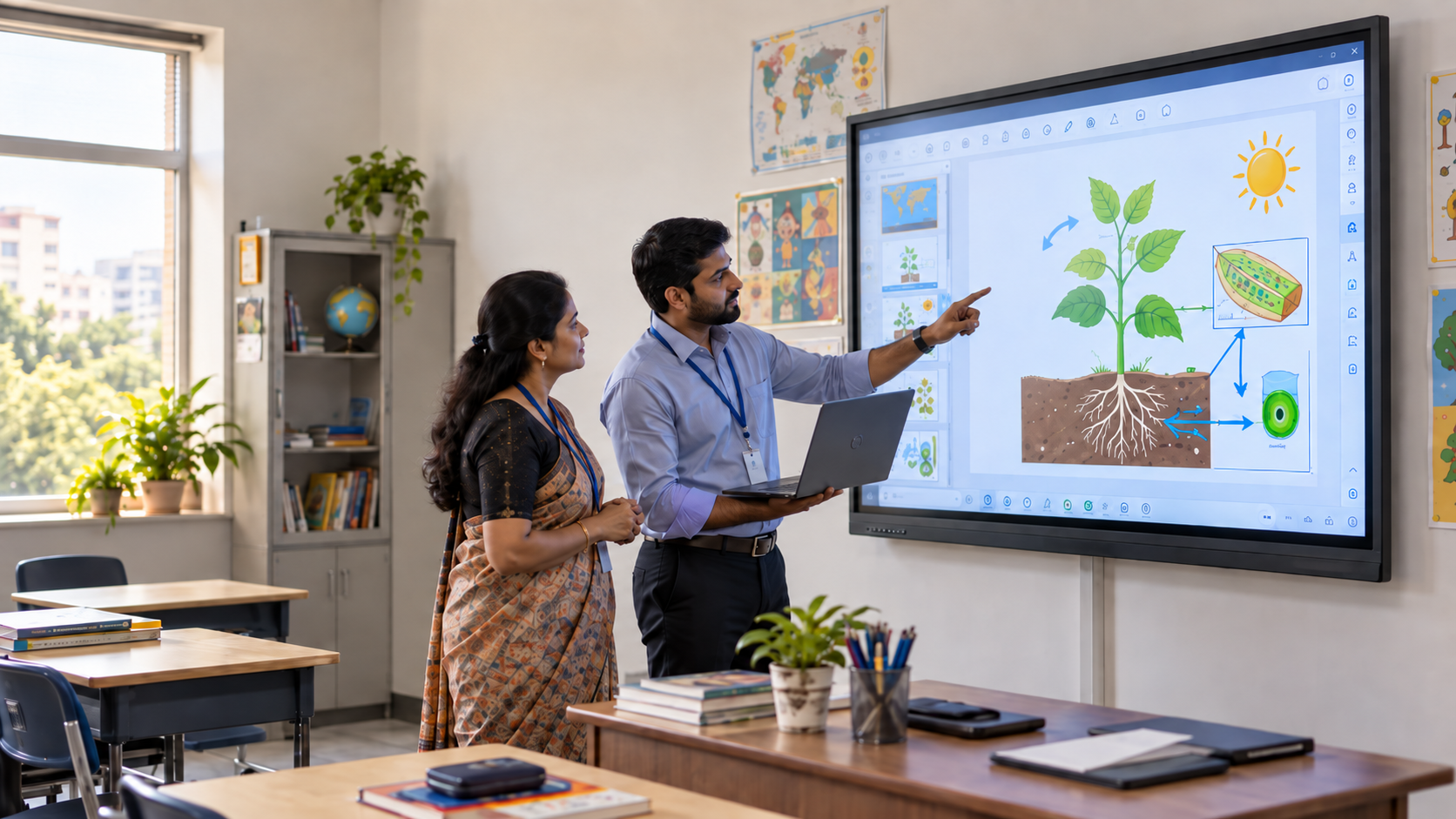
This is where the smart board for the classroom, also known as interactive display, becomes more than just a fancy device. It becomes the bridge. By integrating interactive, visual elements into the lesson, smart boards offer a lifeline that static tools cannot, turning abstract confusion into visible, graspable logic.
The Invisible Wall: Challenges in Teaching Math
Why do students who excel in art or history suddenly freeze up in math class? The answer often lies in the material itself.
The "Abstract" Trap
In early education, math is concrete. You have three blocks; you take away one. But as students progress, math becomes a game of invisible rules.
- Algebra: Suddenly, numbers are letters.
- Geometry: 2D drawings on paper are supposed to represent 3D space.
- Calculus: Students are asked to visualize "rates of change" on static graphs.
For a student struggling with dyscalculia (a specific learning disability affecting number sense) or ADHD, these static representations are essentially noise. They can't "hold" the numbers in their working memory long enough to manipulate them.
The Failure of "Flat" Learning
Traditional teaching relies heavily on the "chalk and talk" method. The teacher solves a problem on the board, and the student copies it. But this method has a critical flaw. It captures the result, not the process. A worksheet shows a fraction, but it doesn't show why 1/3 is bigger than 1/4. It just sits there, flat and unmoving. For a visual learner, this is like trying to learn how to swim by reading a manual.
Why Visual Learning is Crucial
Visual learning isn't just about "pretty pictures". It's a cognitive strategy that bypasses the language processing centers of the brain (which might be overwhelmed) and taps into the visual cortex.
The Brain Science of Visual Math
Research suggests that our brains are hardwired to process visual information 60,000 times faster than text. When a student sees a concept, the brain creates a "dual trace,” one visual and one verbal, doubling the chances of retention. This is vital for math because it grounds abstract ideas in physical reality.
Multimodal Learning
Effective math instruction needs to hit multiple senses:
- Visual: Seeing the graph change shape.
- Auditory: Hearing the explanation (simultaneously).
- Kinesthetic: Physically moving the variables (interacting with the board).
When you combine these via interactive learning, you create a safety net for students who might slip through the cracks of a lecture-only class.
How Smart Boards for Classrooms Enhance Visual Learning
A digital board for classrooms changes the physics of the lesson. It turns math from a spectator sport into a hands-on lab.
1. Dynamic vs. Static
On a regular whiteboard, if you want to change the slope of a line, you have to erase it and draw a new one. On a smart board, the teacher (or student) can simply drag the line, and the equation updates in real-time. This dynamic link between the visual representation and the symbolic equation is where abstract theory finally becomes clear for struggling students.
2. Instant Feedback Loops
Struggling students often make mistakes. They do ten problems wrong and don't realize it until the next day when they get their homework back red-inked. Smart board in the classroom often provides instant validation.
Note: Immediate feedback reduces "math anxiety" because the stakes feel lower. It’s not a permanent failure on paper. It’s a digital attempt that can be retried instantly.
3. Gamification and Engagement
Math can be dry. Interactive boards support interactive math games where solving an equation moves a character or builds a structure. For a student with attention difficulties, this gamification provides the dopamine hit needed to sustain focus on difficult problems.
Specific Math Topics Where Smart Boards Excel
Here is how smart classroom equipment practically rescues students in specific, notoriously difficult areas:

Benefits for Struggling Math Students
The impact of using a smart board for classrooms goes beyond better grades. It changes the students' relationship with the subject.
- Restored Confidence: When a student can "touch" the math and manipulate it until it makes sense, they move from passive confusion to active mastery. Small wins on the big screen build the confidence to tackle harder problems.
- Personalized Pacing: With features like session recording, a student who didn't "get it" during class can re-watch the explanation at their own speed at home. They aren't left behind just because the bell rang.
- Safe Space to Fail: Digital boards allow for easy erasing and undoing. This subtle feature encourages risk-taking. Students are more willing to come up to the board and try, knowing their mistakes aren't permanent.
Roombr’s Smart Board Solutions for Math Classrooms
If you are looking to set up a digital classroom that genuinely supports these students, Roombr offers a holistic solution designed specifically for the Indian education context.
Unlike standard interactive panels that are just large TVs, Roombr transforms your classroom wall into a massive, interactive learning canvas (up to 200 inches).
Why Roombr is the "Math Savior":
- Visibility for All: In a crowded classroom, struggling students often hide in the back. Roombr’s massive display ensures that every student, no matter where they sit, is visually engaged.
- Seamless Curriculum Integration: Roombr isn't just hardware. It comes with pre-loaded, curriculum-mapped content that aligns with Indian standards (CBSE, ICSE, State Boards). Teachers don't have to hunt for resources. They are right there on the wall.
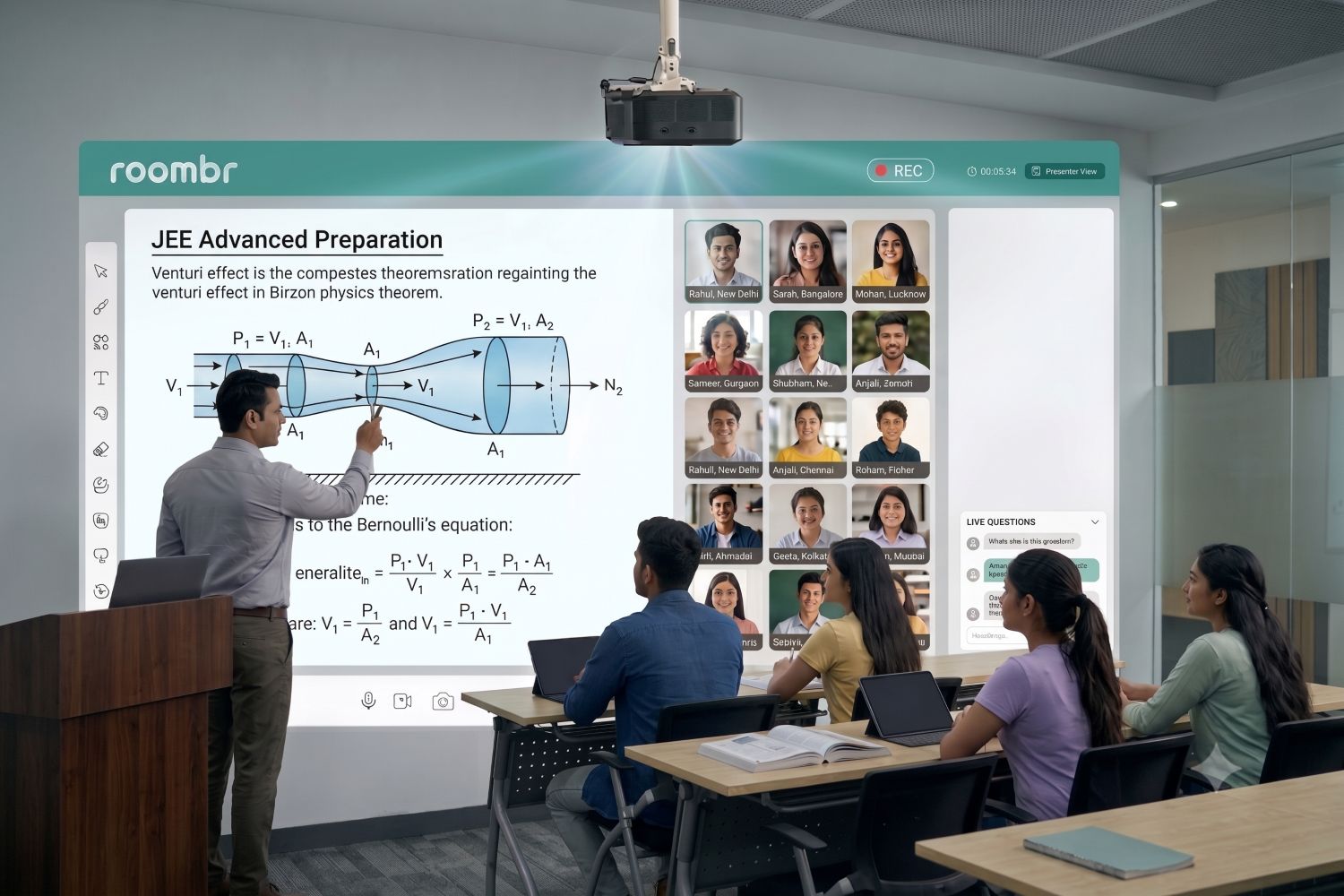
- Auto-Recording for Revision: This is a game-changer for slow learners. Roombr automatically records the classroom session. A student struggling with quadratic equations can go home, log in, and re-watch the teacher explain that specific concept as many times as needed.
- 3D Capabilities: Roombr’s computing unit (powered by Intel i5/i7) handles complex 3D geometry tools effortlessly, allowing teachers to spin, dissect, and explore shapes in ways a textbook never could.
Roombr doesn't just digitize the board. It digitizes the entire pedagogy, making sure no student is left behind because they couldn't "visualize" the answer.
Final Thoughts
Math shouldn't be a gatekeeper that holds students back. It should be a tool they can master. The difference between a student giving up and a student breaking through is often just a matter of how the information is presented.
By adopting a smart board for your classrooms, schools can dismantle the invisible barriers of abstract math. Visual learning aids, supported by interactive technology, turn confusion into clarity and anxiety into confidence.
Frequently Asked Questions
Q1: Do smart boards for classroom use really help students with Dyscalculia?
Yes. Students with Dyscalculia struggle with number sense. Smart boards allow them to use virtual manipulatives (like moving blocks or resizing shapes), which bridges the gap between abstract numbers and physical quantity.
Q2: Is Roombr difficult for older teachers to learn?
Not at all. Roombr is designed with a "Plug-and-Teach" philosophy. If a teacher can use a standard whiteboard and a smartphone, they can use Roombr. Plus, Roombr provides comprehensive teacher training.
Q3: Can we use standard math apps on the Roombr system?
Yes. Roombr runs on a powerful Intel-based computing unit, allowing you to run standard interactive math software, simulations, and educational apps seamlessly.
Q4: Can students interact directly with the board during math lessons?
Yes. Roombr allows students to come up and interact with the board to solve problems, move geometric shapes, or plot graphs. This hands-on participation is key to building confidence in struggling learners.
Q5: Will the smart board work in a brightly lit classroom?
Absolutely. Unlike traditional projectors that require the lights to be turned off, Roombr’s high-brightness projection technology ensures that every decimal point and algebraic variable is crisp and clear for every student, even in a well-lit room during the day.
Q6: Can I record math lessons for students to review later?
Yes. Roombr features a one-click automated session recording. This is especially helpful for struggling math students who may need to re-watch a step-by-step breakdown of a complex equation at their own pace after school hours.
Make Math Tangible with Roombr Digital Classroom
Math shouldn’t be a mountain your students have to climb alone. When a child struggles with abstract equations, they aren't failing. They are simply waiting for the logic to become visible.
Roombr Digital Classroom turns your classroom wall into a living, breathing landscape of discovery where "I don't get it" transforms into "I see it." By replacing static lectures with Roombr’s cinematic, interactive experience, you bridge the gap between confusion and confidence.
Experience the Roombr revolution today. Schedule your live demo and redefine what’s possible in your classroom.

Foziya Abuwala
Share
Step Into the future of
Education with Roombr