

Play-based learning is not a “method” you add to kindergarten. It is the natural way children learn from ages three to six. They learn by moving, copying, talking, singing, touching, pretending, and repeating. They learn with peers. They learn in short bursts. They learn best when the classroom feels safe and playful, and when the teacher can guide the energy.
This is where many smart class setups go wrong. They are designed for older learners who can sit still, read menus, and follow step-by-step instructions. Kindergarten classrooms are the opposite. A system that looks great in a boardroom demo may fall apart in a real room full of excited children.
This article takes a practical approach. It explains the features of a smart classroom that truly support play-based learning in kindergarten, and it shows how to evaluate those features during shortlisting. It is written for school owners, principals, academic coordinators, and program leaders who want better learning outcomes without turning play into passive screen time.
Why Play-Based Learning Needs a Different Smart Classroom Lens
Before we talk about features, it helps to name what “play-based” looks like in real classrooms.
What Play-Based Learning Looks Like On a Normal Day
A typical kindergarten day includes:
- Circle time with songs and movement
- Storytelling with gestures, voices, and role play
- Short games for letter sounds, counting, shapes, and patterns
- Drawing, tracing, and building activities
- Transitions that need quick cues and routines
- Group work where children learn social rules by doing
The teacher is constantly scanning the room. They are guiding attention, switching activities, calming conflicts, and keeping the tone warm. That means the features of a smart classroom must reduce friction, not add it.
Why Many “Smart” Features Fail in Kindergarten
Common breakdowns happen when:
- Only one child can interact at a time, so others drift or disrupt
- The interface expects reading, so children need constant adult help
- The audio is weak, so the teacher repeats instructions again and again
- The system takes too long to start, so the class loses rhythm
- The interactive surface is too small or too high to reach
- Recording or sharing requires too many steps, so it stops happening
In the early years, “good enough” tech becomes abandoned tech. So the right features of a smart classroom are the ones that protect the flow of play.
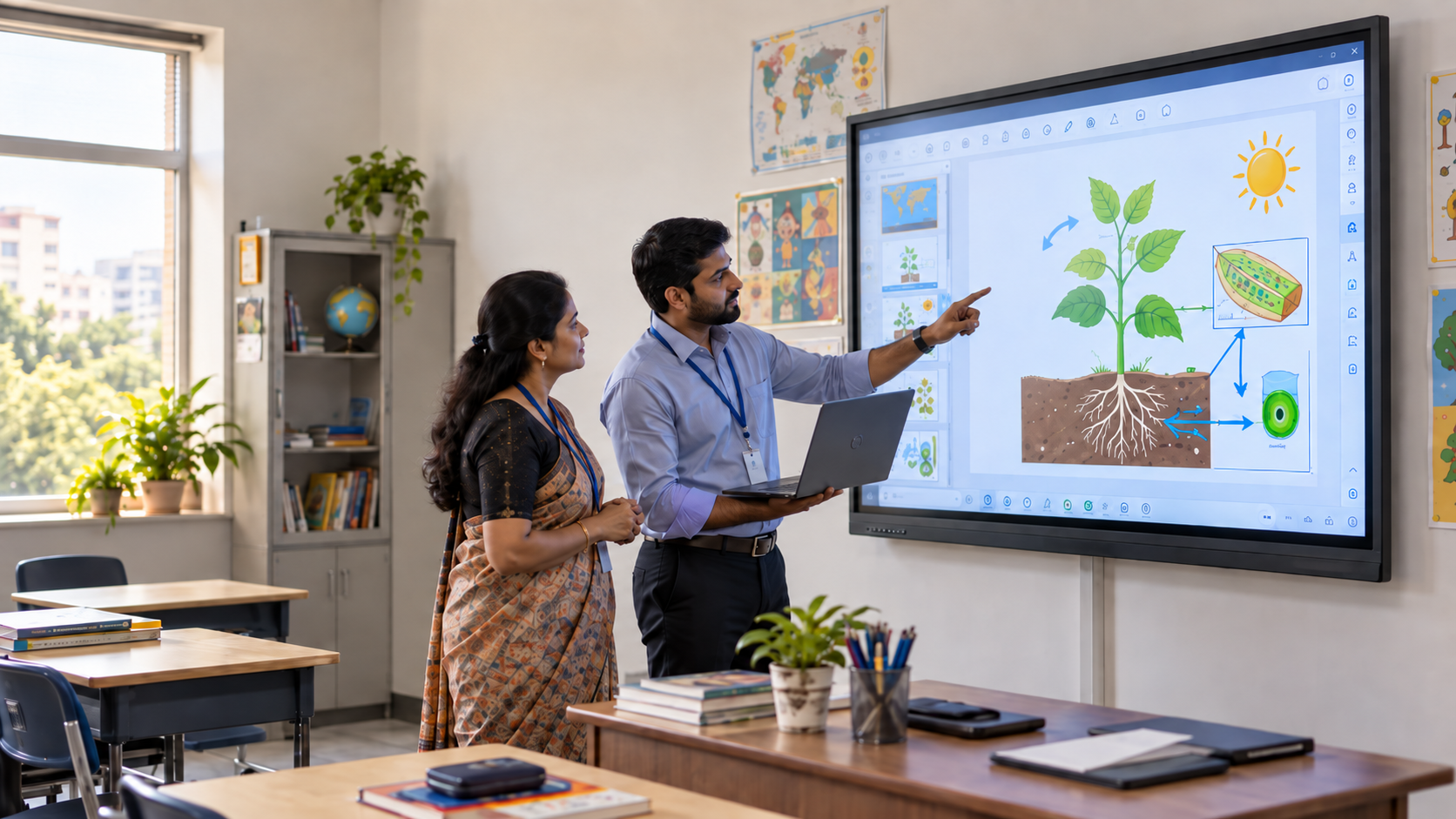
Feature 1: Large Interactive Surfaces that Invite Whole-Body Play
Size is not a luxury in kindergarten. It directly affects participation.
Why Scale Changes Behaviour
When children can interact on a large surface, they do not just watch. They step forward, point, trace with full arm movement, and collaborate. A big interactive space supports:
- Gross motor movement while learning (reach, stretch, tap, drag)
- Group participation without crowding
- Teacher-led games that keep the whole class involved
This supports interactive learning because children are active participants instead of an audience.
What to Evaluate in “Interactive Display” Features
When you assess the features of a smart classroom around the interactive surface, check:
- Reach and Height: Can children touch the main activity area comfortably?
- Accuracy Tolerance: Does it still work with imperfect taps and quick gestures?
- Visibility: Can children at the back see what’s happening clearly?
- Teacher Positioning: Can the teacher stand aside and still guide the activity?
Practical Test During a Demo:
Ask for a simple drag-and-drop sorting activity (colors or shapes). Invite two or three children (or adults acting like children) to interact at once. Watch if the interaction feels smooth or if it turns into “one at a time.”
Feature 2: Multi-Touch and Multi-User Interaction for Shared Play
Kindergarten play is social. Learning is social. The technology should be social too.
Why Single-User Interaction Breaks the Room
When only one child can interact:
- The rest wait, and waiting becomes mischief
- The teacher spends time managing turns
- Participation shrinks to “performer and audience”
That hurts collaborative learning. It also makes classroom management harder.
Multi-User Interaction Features that Matter
Strong features of a smart classroom in kindergarten support:
- Multi-touch input so more than one child can interact
- Simultaneous drawing so pairs can create together
- Group games that teach turn-taking in a playful way
- Fast reset so the teacher can switch to the next group quickly
Classroom Example:
A “match the sound to the picture” activity works best when two children come up together: one listens and points, the other drags the item. Children learn language and social cooperation at the same time.
Evaluation Questions to Ask Vendors
- How many simultaneous touch points are supported without lag?
- Does the system stay responsive when multiple children interact quickly?
- Are there ready-to-use activities designed for group interaction?
These questions keep the conversation grounded in real features of a smart classroom, not vague claims.
Feature 3: Audio-First Capabilities for Phonics, Songs, and Routines
In kindergarten, audio often matters more than visuals. Children learn language through sound.
Why Audio Quality Drives Learning Outcomes
Phonics, rhymes, call-and-response, and storytelling build:
- Listening stamina
- Sound discrimination
- Vocabulary growth
- Confidence in speaking
If the audio is weak, children lose the thread. The teacher repeats, the room gets louder, and the activity loses joy. Good audio supports effective teaching because it makes routines effortless.
What to Look for in Audio-Related Features
When evaluating the features of a smart classroom, focus on:
- Room-filling speakers that remain clear at lower volumes
- Sensitive microphones that pick up normal classroom voices
- Noise handling that keeps speech understandable in busy rooms
- Multiple mic options if the teacher moves around a lot
Practical Classroom Use:
Transition songs are a secret weapon. A clean, consistent “cleanup song” cue reduces chaos and improves classroom management. The audio feature is not a bonus. It is a daily tool.
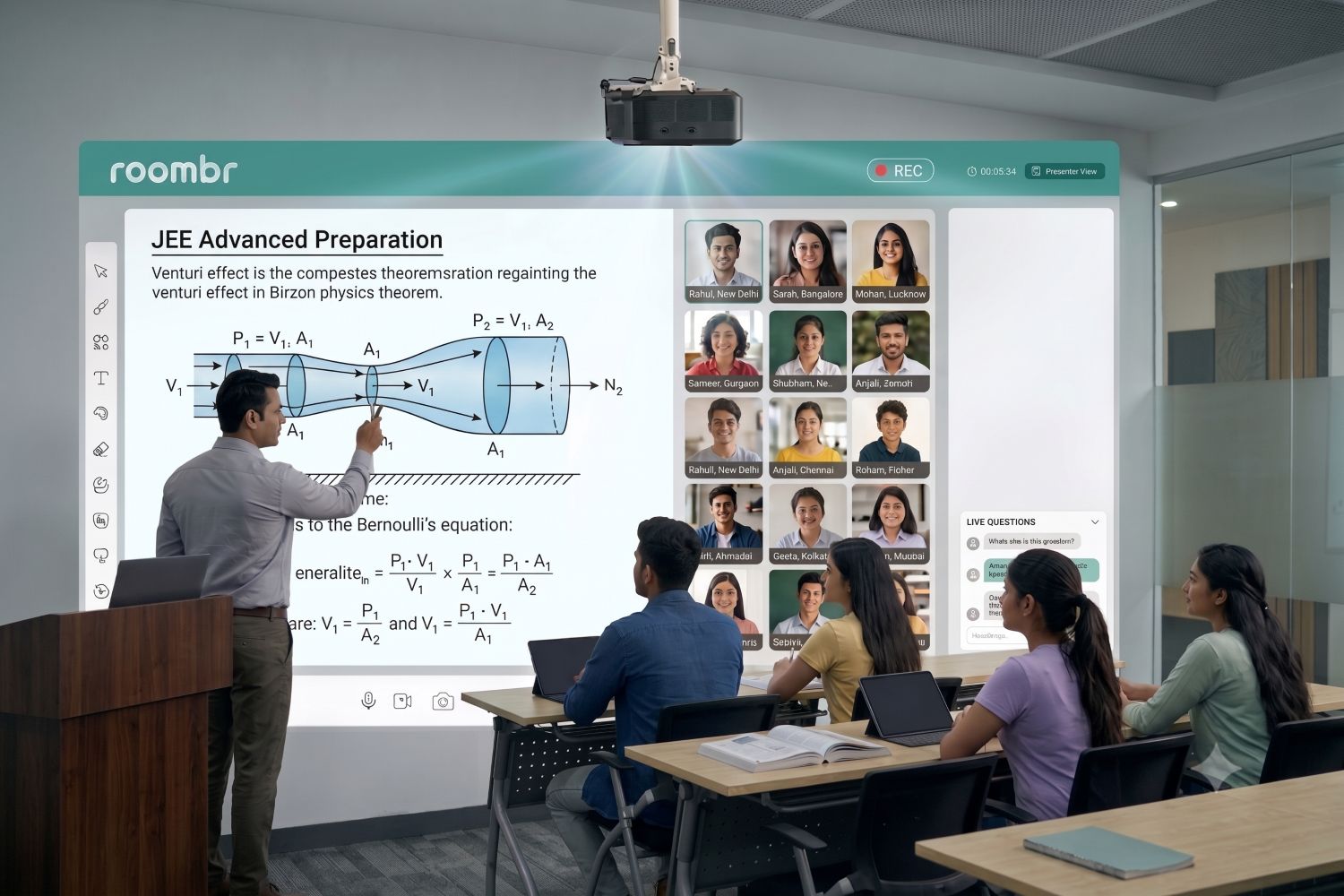
Feature 4: Recording that Supports Reinforcement
In kindergarten, recording should serve learning and communication, not surveillance.
Why Recording Helps Play-Based Learning
Young children need repetition. A recorded storytelling session, rhyme, or activity becomes a reusable learning asset. Recording supports:
- Revision through replay (children love repeating songs and stories)
- Support for children who missed a class or need extra time
- Teacher reflection: what worked, what didn’t, what to repeat
- Parent communication showing progress through real classroom moments
These are learning outcomes you can actually see.
Recording Features that Matter in Daily Practice
The best recording-related features of a smart classroom are:
- Start/Stop Simplicity: One or two steps, not a complex workflow
- Reliable Capture: Clear audio and stable video
- Flexible Storage: Recordings don’t disappear or become hard to retrieve
- Smart Organisation: Sessions should be easy to locate by date or class
Practical Tip for Early Years Teams:
Set a simple routine: record one 2–4 minute “learning moment” twice a week (a rhyme, a group counting activity, a show-and-tell clip). Short is the key. Short clips get used. Long videos get ignored.
Feature 5: Replay that Makes Learning Stick at Home
Replay is not about more screen time. It’s about reinforcement in small doses.
How Replay Improves Learning Outcomes
A child who replays a story or rhyme:
- Learns new words without pressure
- Picks up rhythm, pronunciation, and patterns
- Builds confidence through familiarity
- Brings classroom language into home conversations
This strengthens learning outcomes without turning learning into drills.
Features that Make Replay Usable For Families
Replay-related features of a smart classroom should include:
- Simple sharing with access control
- Compatibility across common devices
- Quick loading so parents don’t give up
- Clear titles or labels so families know what the clip is
A Strong Signal:
If a system makes replay hard, schools stop sharing. If sharing is easy, sharing becomes part of the school’s identity, and parent trust improves.
Feature 6: Assessment Tools that Don’t Interrupt Play
Assessment in kindergarten should feel like play, not a test.
Why Formal Tests Backfire in Early Years
Long tests and strict scoring:
- Reduce curiosity
- Create anxiety
- Push teachers toward rote methods
But schools still need visibility into progress. The answer is an assessment that happens during activities.
What “Gentle Assessment” Features Look Like
Helpful features of a smart classroom include:
- Micro checks inside games (match, sort, trace, count)
- Teacher's view of participation and common mistakes
- Progress patterns over time (not just one-day results)
- Quick follow-up tasks for children who need extra support
This supports effective teaching because teachers can adjust instruction without stopping the fun.
A Simple Way to Use Assessment Without Pressure
- Run a shape-sorting game as a group activity
- Observe who struggles with the triangle vs the square
- Give a short follow-up activity the next day
- Track improvement through repeated play
That is remedial teaching without stigma.
Feature 7: Performance and Stability that Protects the Rhythm of Play
In kindergarten, speed is not about convenience. It’s about control.
Why Lag Ruins a Learning Moment
When the system freezes or lags:
- Children stop listening
- Side conversations grow
- The teacher loses the “attention window”
- The activity becomes behaviour management
So performance is part of classroom management.
What to Evaluate for Performance
When reviewing the features of a smart classroom, test:
- Startup Time: Can the teacher start quickly during a busy morning?
- Switching Speed: Can they move from song to game to drawing fast?
- Multi-Touch Responsiveness: Does it lag when multiple children interact?
- Audio-Video Stability: Does sound stay synced and clear?
Demo Script to Request:
Ask the vendor to run a three-part sequence without pausing:
- Play a rhyme
- Open a drag-and-drop activity
- Open a free-draw activity
This mirrors real teaching and reveals performance issues fast.
Feature 8: Teacher-First Controls that Keep the Class Flowing

Teachers need control without complexity.
What Teachers Actually Need in the Moment
In a kindergarten classroom, a teacher often needs to:
- Pause instantly
- Restart quickly
- Switch to a different activity without digging through menus
- Pull up a routine song on demand
- Bring attention back when energy spikes
So the features of a smart classroom should feel like a “teacher tool,” not a tech product.
Practical Usability Features to Look For
- Large, clear icons instead of text-heavy navigation
- Quick access panels for frequent activities
- Easy input methods that don’t require a desk setup
- Remote control options so the teacher isn’t stuck at the front
This supports effective teaching because the teacher stays with the children, not with the device.
Feature 9: Safety, Reliability, and Quality Signals that Matter In Early Years
Safety is not a separate checklist. It is part of the feature evaluation.
What Safety Looks Like in Kindergarten Classrooms
Children touch, run, bump, spill, and tug. Systems should be built for reality:
- Safe placement that avoids reachable hazards
- Good cable discipline (or minimal cables in reach)
- Stable mounting to avoid movement or wobble
- Safe operating temperatures during long sessions
Trust Signals Evaluators Should Look For
Alongside daily usability, procurement teams often look for:
- Recognised quality standards
- Testing and certification evidence
- Build reliability suited for frequent daily use
These points belong in a feature discussion because they affect adoption and classroom confidence.
Putting It All Together: A Practical Evaluation Checklist
Use this as a shortlisting tool. It keeps evaluation tied to play-based learning.
Interactive and Group Play
- Do the features of a smart classroom support a large interactive area?
- Can two to four children interact at once without lag?
- Can the teacher run group activities without constant turn management?
Audio and Engagement
- Are speakers clear at normal volume?
- Do microphones capture speech clearly in a noisy room?
- Can the teacher run songs and phonics games without extra equipment?
Recording and Replay
- Can the teacher record in two steps or fewer?
- Is replay easy for families to access and understand?
- Are recordings organised so teachers can reuse them?
Assessment and Learning Outcomes
- Are there activity-based checks that feel like play?
- Can teachers see patterns that help remedial teaching?
- Do these features of a smart classroom help track learning outcomes without formal tests?
Daily Usability and Classroom Management
- Is startup quick enough for real mornings?
- Can the teacher switch activities instantly?
- Are controls simple enough for consistent daily use?
Safety and Reliability
- Is the setup safe for young children?
- Are there strong quality signals and durability expectations?
- Does the system handle full-day use without overheating or instability?
Final Thoughts
In kindergarten, children barely notice the best technology in the classroom. They notice the story, the song, the game, the drawing, the laughter. They notice the teacher. They notice each other. That’s the real test of the features of a smart classroom.
When you evaluate smart class tools through this lens, you get better adoption, better teaching flow, and better outcomes. Most importantly, you protect what kindergarten is meant to be: joyful, social learning that feels like play.
Turn Your Kindergarten Classroom into a Hub of Joyful Discovery with Roombr
Choosing the right features of a smart classroom shouldn’t feel like a compromise between technology and play. At Roombr, we’ve designed a holistic digital smart classroom solution that disappears into the background so teaching can take center stage. From life-sized interactive learning surfaces to seamless classroom management tools, Roombr empowers educators to foster collaborative learning without the friction of traditional tech.
Ready to see how the right technology in the classroom can amplify learning outcomes and make effective teaching feel effortless?

Foziya Abuwala
Share
Step Into the future of
Education with Roombr