

Most teachers have experienced this: you finish a chapter, students seem fine in class, and then the test shows gaps. The usual fix is “revise again,” but that consumes time and still misses the point.
Competency-based planning works better because it starts with what students should be able to do after the chapter. Not what you “covered,” but what they can show.
This post discusses simple teacher tools to turn any chapter into three clear learning outcomes. It also explains a short lesson flow and quick assessment tools you can use in one period.
What “Competency-Based” Looks Like in a Real Classroom
A chapter has many parts, including definitions, examples, exercises, diagrams, and activities. A competency-based lesson plan pulls out the actions students must perform with that content.
Think of it like this:
- Content = what’s in the textbook
- Competency = what students can demonstrate using that content
- Proof = what you collect in class to know learning happened
The goal is not long lesson plans. The goal is clearer outcomes and faster checking. That is what these teacher tools are designed for.
The 5 Teacher Tools You’ll Use (Low Prep, Repeatable)

Use these as a mini toolkit. Once you create them, you can reuse them for every chapter.
- Chapter Core Picker (5 lines)
A tiny box where you list: the big idea, 3 must-know terms, 1 common mistake, and 1 real-life link.
- 3-Outcome Skill Card (one chapter = three skills)
The main tool. It forces clarity and stops the “too many goals” problem.
- Activity Ladder (easy → standard → stretch)
One task per level, so every class has an entry point and a challenge point.
- Evidence Checklist (what counts as proof)
A short list of what you will collect for each outcome.
- Exit Ticket + Mini Rubric (2 minutes to check)
Use three short questions linked to the three outcomes and add a simple scoring guide. These teacher tools help you plan faster, teach with focus, and check learning quickly.
Step-By-Step: Turn One Chapter into Three Learning Outcomes
Use this method for any subject and any grade.
Step 1: Pick the Chapter Core
Open the chapter and fill the Chapter Core Picker:
- Big idea (one sentence)
- 3 terms students must use correctly
- 1 misconception students usually have
- 1 real-life connection (home, school, local examples)
This keeps the chapter teachable. It also prevents planning from becoming a long list.
Step 2: Choose Three Skills (Not Three Topics)
Now write three outcomes using a fixed pattern. This is the part most teachers might overcomplicate. Keep it consistent:
- Understand (concept skill): Students can explain…
- Apply (use skill): Students can solve/use/perform…
- Justify (reasoning skill): Students can defend a choice, compare options, or explain a “why”…
If you use the same three-skill pattern every time, your lessons become easier to plan, and students learn what success looks like.
Step 3: Make Each Outcome Observable
A good outcome can be seen in student work. Skip vague outcomes like “students will understand” or “students will learn.” Use clear, measurable actions instead, such as:
- “Explain in 3 sentences”
- “Solve 2 mixed problems”
- “Justify using one reason + one example”
That last step is what turns outcomes into something you can check with assessment tools.
Worked Example: One Chapter Turned Into Three Skills (Science)
Chapter example: Photosynthesis (middle school)
Chapter Core Picker
- Big idea: Plants make food using light energy.
- Must-know terms: chlorophyll, carbon dioxide, glucose.
- Common misconception: Many students believe plants get their food from the soil.
- Real-life link: Why plants grow differently in shade vs sunlight.
3-Outcome Skill Card
- Outcome 1 (Understand): Students can explain photosynthesis in their own words using the three terms correctly.
- Outcome 2 (Apply): Students can predict what happens when one factor changes (less light / less water / less CO₂) using a short scenario.
- Outcome 3 (Justify): Students can explain why their prediction makes sense, using a simple cause-and-effect chain (If… then… because…).
This example is specific enough to teach in one period, and broad enough to reuse in revision.
Turn Those Outcomes into a 40-Minute Lesson
Here’s a simple flow you can reuse with any chapter. These steps pair well with the teacher tools.
- Start (5 minutes): Outcome preview + misconception check
Ask: “Do plants take food from soil?” Students vote, then give one reason. - Teach (12 minutes): Clear explanation + quick diagram
Draw a simple process diagram. Keep it clean. Use the three terms. - Guided practice (10 minutes): Activity Ladder (easy → standard)
- Easy: match terms to meanings
- Standard: complete a partly-filled diagram
- Stretch (8 minutes): Reasoning prompt (Outcome 3)
Scenario: One plant sits by a sunny window, while the other is kept in a dim corner. Predict and explain growth difference.” - Check (5 minutes): Exit ticket
One question per outcome.
If time slips, keep Outcomes 1 and 2 in class. Give Outcome 3 as a short written prompt that students finish after class.
Evidence Checklist: What “Proof” Looks Like For Each Outcome
The outcomes are fine. But the lesson plan may fail if the teacher is not ready with what proof they want to collect.
Use this checklist:
- Outcome 1 proof: 3 correct statements OR a labeled diagram with correct terms
- Outcome 2 proof: One scenario solved correctly OR two quick predictions with reasons
- Outcome 3 proof: A short “If… then… because…” explanation that shows cause and effect
Now your assessment tools are not random. They match what you said you wanted students to do.
Exit Ticket Template
Keep it short. Three questions, one per outcome:
- Explain photosynthesis in 2–3 sentences using the three terms.
- If light reduces, what happens to food-making? Choose one option and write one reason.
- A plant in the shade grows slowly. Explain why using “If… then… because…”
Mini Rubric (0–2)
- 0 = not shown
- 1 = partly shown
- 2 = shown clearly
This takes minutes, not hours. And it gives you clean next steps for the next class.
How This Supports Blended Learning Without Extra Workload
Competency-based planning becomes stronger when students can revisit explanations and practice at their own pace. That’s the heart of blended learning: in-class teaching plus structured follow-up that students can access again.
A simple way to do this:
- Capture a 2–3 minute recap of Outcome 1 (the core idea).
- Share it with students as revision support.
- Use the exit ticket results to decide who needs extra practice for Outcome 2 or Outcome 3.
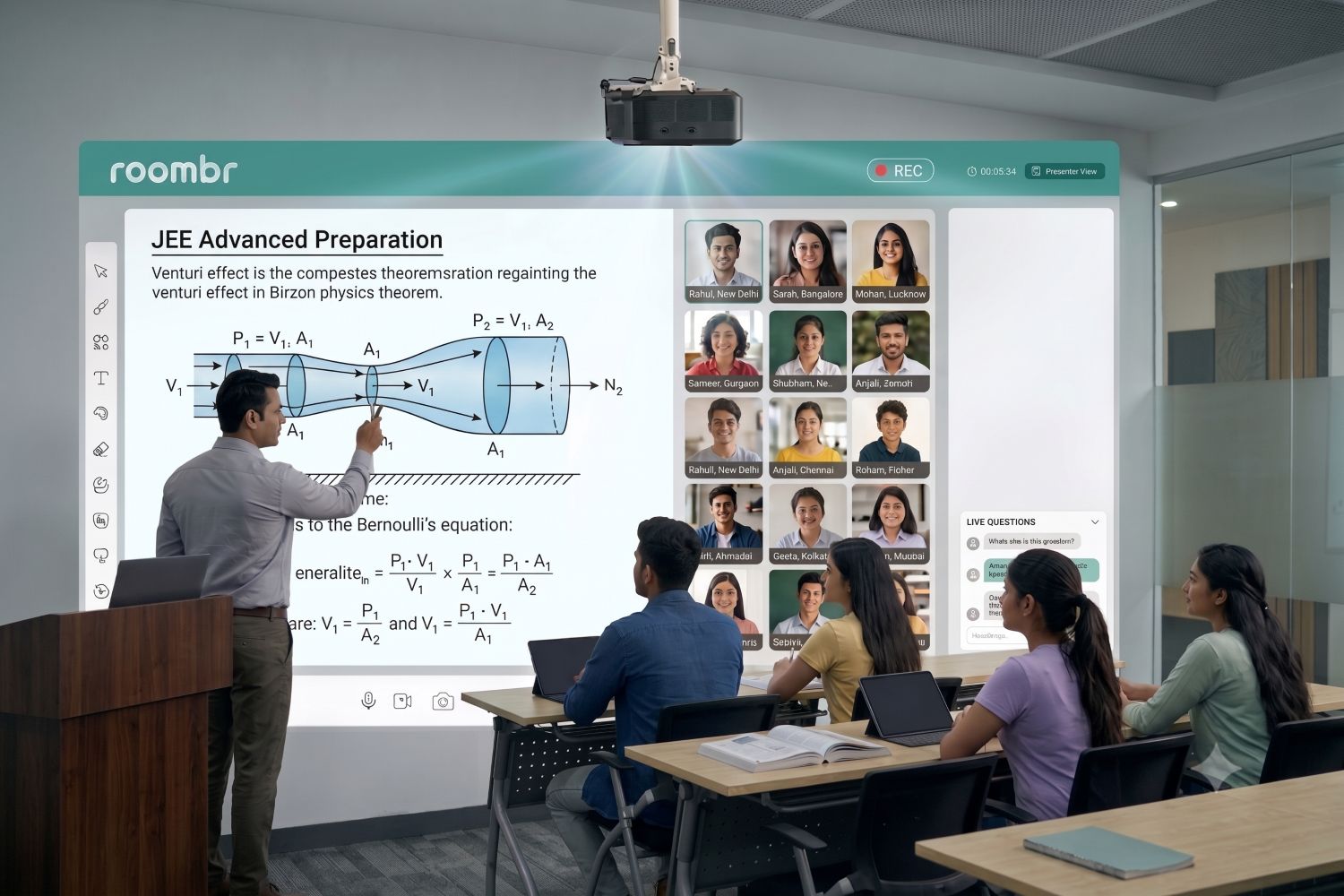
Roombr fits here as a classroom system that supports live teaching and lesson capture, so students can revisit key parts and teachers can reuse the same content across sections without repeating everything.
Common Mistakes (And Quick Fixes)
- Mistake: Outcomes sound like activities (“do worksheet”).
Fix: Outcomes must be skills (“solve and explain”). - Mistake: All outcomes are recall.
Fix: Keep the third outcome for reasoning. - Mistake: Tests don’t match outcomes.
Fix: Build the exit ticket right after writing the outcomes.
Try This With Your Next Chapter
Pick one chapter. Write three learning outcomes using the same pattern. Create one exit ticket that matches them. That’s it.
With these teacher tools, you’ll plan faster, teach with more focus, and use assessment tools that actually show what students can do.
See how Roombr’s plug-and-play digital classroom can support outcome-based teaching with interactive lessons, built-in recording, and easy replays for students.

Foziya Abuwala
Share
Step Into the future of
Education with Roombr