

As Indian schools, universities, and coaching institutes scale their hybrid learning models, a massive gap appears between isolated devices and truly connected ecosystems. Many IT directors and franchise owners are realizing that buying basic hardware creates long-term technical debt and severe network vulnerabilities.
This comprehensive guide explores how emerging technologies in education are changing the institutional procurement process completely. By evaluating an interactive panel as the central hub of an Internet of Things (IoT) network, educational leaders can build a future-proof connected campus.
We will break down exactly how this strategic network approach lowers operational costs, secures proprietary data, and streamlines daily administrative operations across multiple branches.
Introduction to the Connected Campus
Institutions often create massive data silos during their digital transformation. They buy interactive panels, network cameras, and software from different vendors running on closed APIs. This fragmented network architecture prevents classroom devices from sharing critical data during a live hybrid session. An all-in-one IoT hub eliminates these blind spots by processing all audio, video, and environmental data through a single, secure gateway.
A connected campus solves this data problem beautifully. It relies on a central command center that speaks natively to every other device on the network. When you deploy a premium interactive panel, you are not just buying a display. You are investing in a powerful IoT gateway. This gateway brings together security systems and audio-visual peripherals under one seamless interface. The result is a frictionless teaching environment where technology works invisibly in the background.
Understanding the Shift from Screens to Smart Hubs
Over the last decade, classroom hardware evolved from overhead projectors to standard interactive flat panels. However, a standard panel is still functionally a standalone device. It requires external laptops to run complex software. It needs cables to connect to the room speakers. Most importantly, it does not communicate with the physical room around it or the broader campus network.
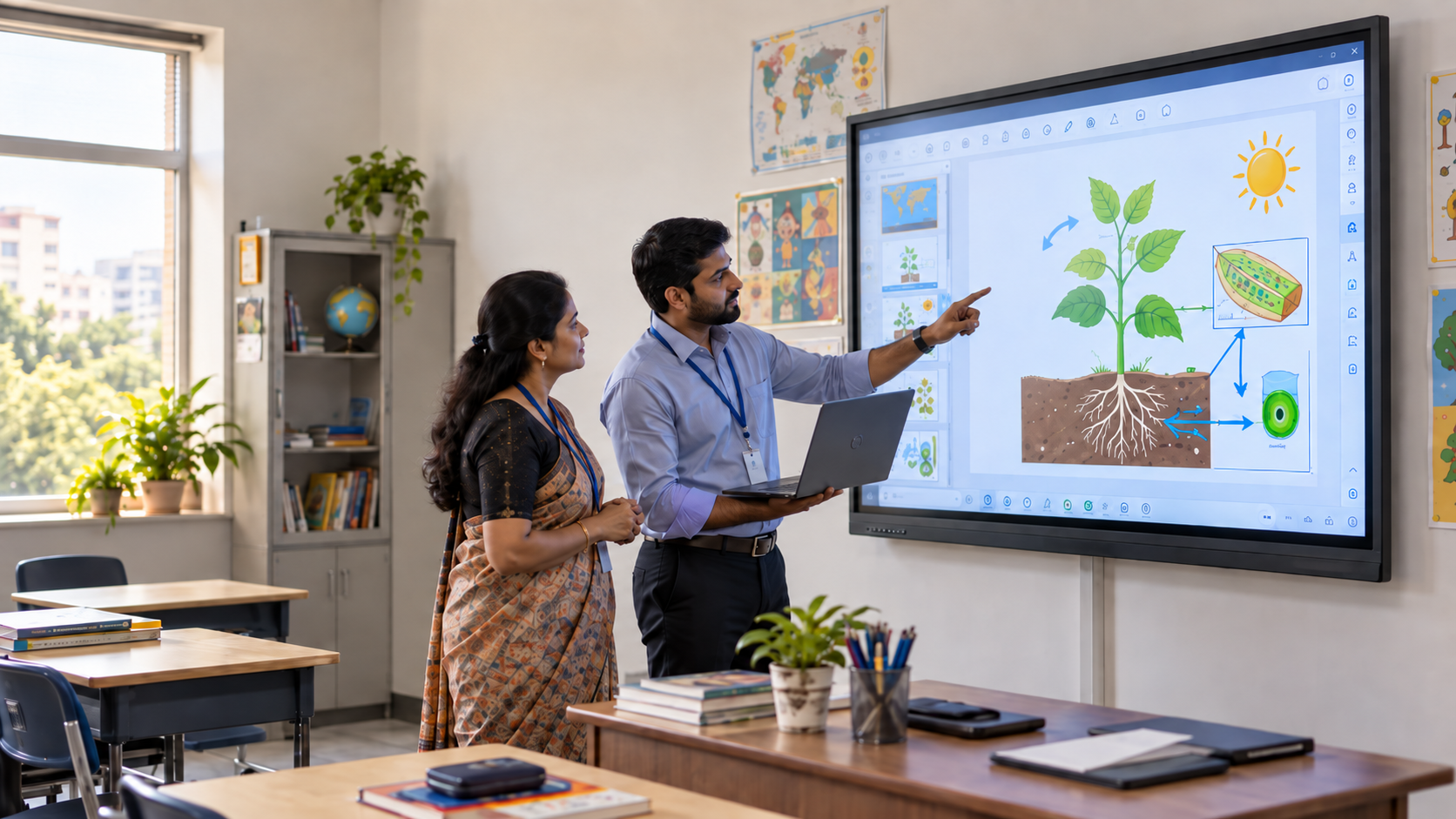
Today, the role of digital technology in education demands much deeper integration to justify the investment. An IoT-enabled interactive panel acts as the intelligent brain of the classroom. It features built-in diagnostic sensors, open API access for custom integrations, and native cloud connectivity. This allows the board to send and receive data from other smart devices instantly over secure IP protocols.
Roombr leads this industry shift by offering a natively integrated digital classroom ecosystem. Instead of forcing IT departments to manage overlapping IP addresses and conflicting third-party firmware, Roombr provides an all-in-one IoT solution. This holistic network approach allows environmental sensors, biometric scanners, and the main display to communicate over a single encrypted protocol.
Core IoT Capabilities to Look For in An Interactive Panel

When evaluating new hardware for your institution, you must look beyond basic screen resolution and touch response times. You must vet the device based on its ability to control the wider ecosystem and process large amounts of network data without crashing.
Secure Access and Cloud Profile Syncing
Security and daily convenience are major challenges in shared campus environments. A true IoT hub personalizes the teaching experience the moment an educator enters the room. Instead of typing vulnerable passwords on a shared screen, teachers can simply tap an RFID card on the interactive panel. The system instantly authenticates the user over the secure network. It automatically pulls their personalized cloud drives, saved browser tabs, and daily lesson plans directly onto the display. This advanced approach to classroom management ensures that teachers can start a hybrid class in seconds. When the lecture ends, a single tap logs them out instantly.
Automated Attendance and Biometric Syncing
Taking manual attendance roll calls wastes thousands of valuable teaching hours every academic year. Advanced IoT setups eliminate this highly inefficient practice. Institutions can connect RFID readers or biometric fingerprint scanners directly to their interactive panel.
When students walk into the room, they simply scan their ID cards. The panel processes this data instantly and updates the central cloud server. This transforms traditional classroom management into an invisible, automated process. Teachers can start their academic lessons immediately. Meanwhile, administrators get real-time attendance reports on their dashboards, and parents receive instant SMS notifications about their child's arrival.
Energy Management and Sustainability
Running hundreds of large interactive screens across a large university campus draws massive amounts of power. Power fluctuations and wasted electricity are major concerns in many Indian cities. IoT sensors solve this by actively monitoring room occupancy and usage patterns.
If a classroom sits empty for fifteen minutes after a lecture ends, the motion sensors alert the interactive panel. The board then automatically powers down all connected peripherals like cameras and speakers, before entering a deep sleep mode. This smart energy management drastically reduces monthly electricity bills. It also protects the internal components from unexpected power surges and helps large educational institutions meet their environmental sustainability goals.
How an IoT Hub Transforms Hybrid Teaching
The true test of classroom technology happens when you blend physical attendees with remote learners. An IoT-centric approach guarantees that neither group feels left out of the academic experience and that the network can handle the heavy data load.
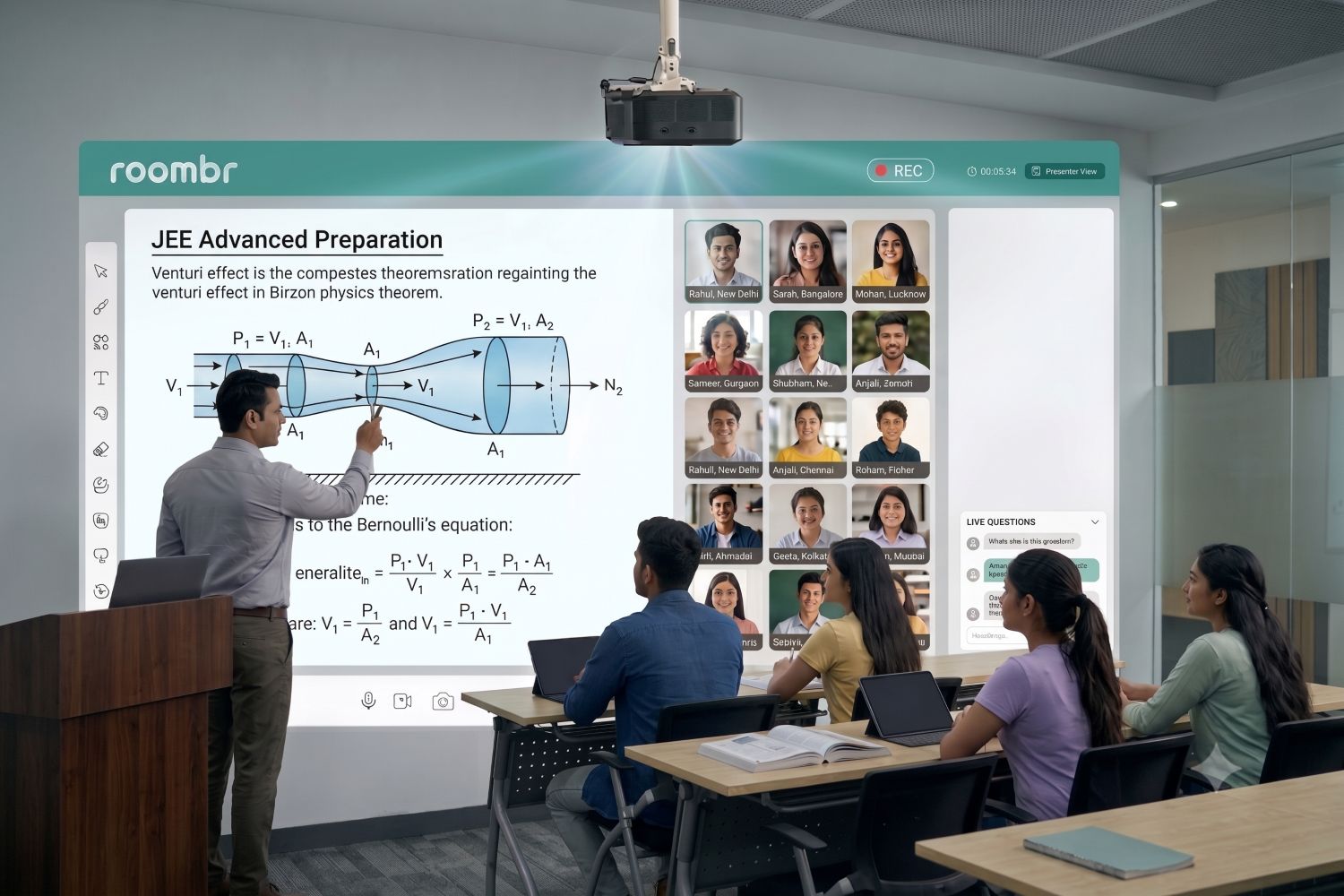
Seamless AV Syncing for Remote Learners
Poor audio and video quality will instantly destroy a premium hybrid class. Traditional setups force teachers to act as full-time technical support agents. They have to manually switch between different camera angles and adjust microphone volumes while trying to teach a complex subject.
An IoT-connected interactive panel removes this heavy friction completely. It integrates natively with advanced Pan-Tilt-Zoom (PTZ) tracking cameras and spatial audio microphone arrays. As the teacher walks naturally across the stage, the camera follows them smoothly. The microphones automatically isolate their voice and cancel out disruptive background noise using advanced acoustic echo cancellation algorithms.
This flawless synchronization ensures that remote students experience the same production quality as the students sitting in the front row. It enables true digital collaboration in classrooms where everyone can ask questions and participate without lag, echo, or technical disruptions.
Real-Time Data Analytics for Educators
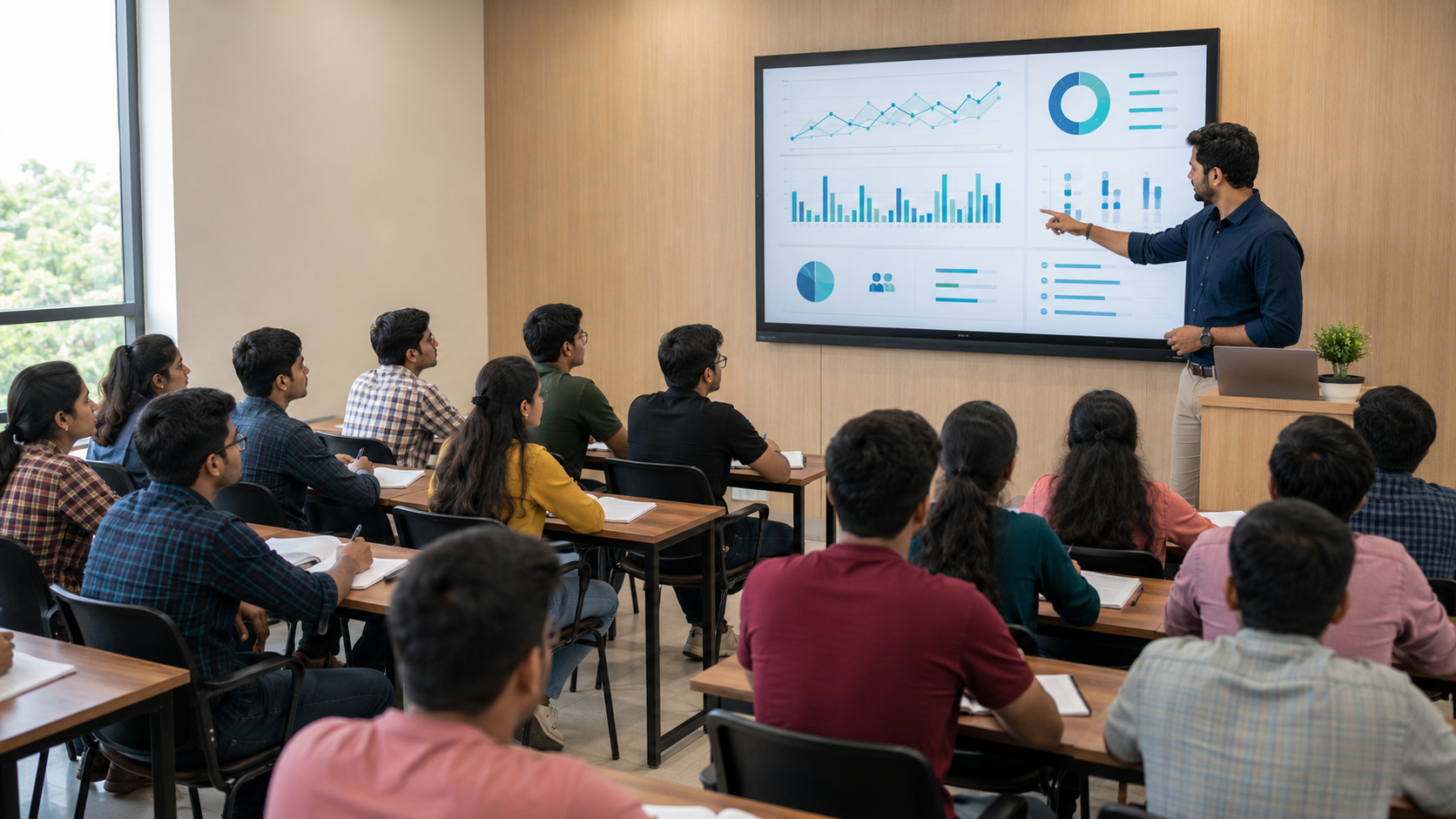
Data drives better academic outcomes. An IoT hub does not just passively display PDF documents and slides. It actively measures how students interact with that specific content. The interactive panel tracks which interactive 3D models get the most use. It monitors the exact duration of specific group activities and gathers live analytics during rapid-fire quizzes.
Academic directors and franchise owners can use this granular data to see what teaching methods actually work. They can identify which specific topics cause students to struggle. They can then refine their core curriculum based on actual usage patterns rather than relying on guesswork.
Infrastructure Requirements for Institutional Deployment

Deploying an IoT-enabled connected ecosystem requires careful planning. IT directors must ensure their campus infrastructure is ready to handle the demands of continuous data synchronization and secure network traffic.
Network Bandwidth and Latency Standards
A connected ecosystem relies heavily on a robust and stable network. IT teams must ensure their campus Wi-Fi can support heavy, continuous IoT traffic. When multiple biometric scanners, cameras, and tablets communicate simultaneously with an interactive panel, the local network must handle rapid data packets without dropping the connection.
Institutions need enterprise-grade routers and sufficient dedicated bandwidth to prevent system latency. This is especially critical during live hybrid broadcast sessions where even a two-second audio delay can ruin the learning experience. Furthermore, the best systems offer strong offline fallback modes. If the internet drops temporarily, the board should still function locally and sync all the stored attendance and usage data once the connection returns.
Security Protocols and Data Privacy
Expanding the number of connected smart devices naturally increases the potential attack surface for cyber threats. Security is absolutely the most critical factor when evaluating an IoT-enabled interactive panel. Coaching institutes must protect their highly valuable proprietary study materials from digital piracy.
Enterprise buyers must look for strict end-to-end encryption standards. The interactive panel must use secure network protocols to prevent unauthorized access to the broader campus network. Roombr builds its entire ecosystem with enterprise-grade security architecture. This strict framework ensures that all student data, recorded video lessons, and internal faculty communications remain completely safe from external breaches.
Calculating the True ROI of an IoT-Driven Solution
Financial decision-makers must look past the initial sticker price of the hardware. The most expensive interactive panel is the one that breaks down constantly and requires a massive IT team to keep it running securely.
Predictive Maintenance Cost Savings
Hardware breakdowns disrupt live classes and frustrate paying students. Traditional maintenance is entirely reactive. You only call the technician after the board breaks. An IoT-connected interactive panel offers highly advanced predictive maintenance.
Built-in diagnostic sensors constantly monitor internal board temperatures, CPU load, and background memory usage. If a core component starts to overheat or a software driver begins to fail, the board sends an automated early warning alert to the central IT department long before a total system failure occurs.
IT staff can then deploy over-the-air firmware updates remotely or schedule physical maintenance during weekend off-hours. This proactive approach eliminates unexpected classroom downtime and drastically reduces emergency repair costs.
Lowering Total Cost of Ownership
Securing one hundred fragmented network endpoints across a university requires a massive cybersecurity budget and tedious manual firmware patching. A holistic ecosystem changes this financial math completely. By functioning as a centralized IoT hub, an all-in-one interactive panel processes all device health metrics and software updates over the air. This drastically reduces enterprise IT overhead and eliminates the need for bridging software.
Furthermore, the board feeds crucial data directly into your existing school erp software. This native database integration removes the need to buy expensive third-party data bridging tools or hire data entry clerks. When you factor in the automated predictive maintenance, the daily energy savings, and the heavily reduced IT overhead, a holistic ecosystem delivers a vastly superior return on your educational investment.
- Traditional Setup Costs: High IT staffing costs, separate software licenses, replacement parts for external webcams, high energy waste, and massive cybersecurity vulnerabilities.
- IoT Ecosystem Costs: Centralized remote management, consolidated native software, single vendor accountability, automated energy reduction, secure single-point encryption.
Conclusion and Next Steps for Administrators
The future of the Indian education sector relies entirely on smart and connected infrastructure. Viewing an interactive panel as a mere presentation screen limits its vast potential and wastes valuable institutional budgets. By embracing a strategic IoT-driven network approach, IT directors, school administrators, and coaching business owners can build a highly scalable, financially efficient, and deeply engaging learning environment.
The Roombr ecosystem provides all the necessary integrated tools to transform a standard concrete learning space into a holistic smart campus. We strongly encourage academic leaders to stop buying fragmented, isolated hardware that creates data silos. It is time to start investing in comprehensive solutions that scale safely with your ambitions.
Frequently Asked Questions (FAQs)
1. What makes a digital board an IoT hub?
A standard screen only displays images. An IoT hub actively connects with other smart classroom devices. When you use an advanced interactive panel, it communicates instantly with biometric scanners, room lighting, and tracking cameras to automate your entire teaching environment.
2. How does an IoT-enabled interactive panel help teachers during hybrid classes?
It removes all technical distractions. A connected interactive panel automatically syncs spatial audio microphones and PTZ cameras. The teacher simply walks in and starts the lesson while the IoT ecosystem handles the live broadcast for remote students effortlessly.
3. Can existing classroom tech connect to a new interactive panel?
Yes. A holistic smart classroom ecosystem features open API access and universal plug-and-play ports. This allows institutions to connect legacy document cameras or existing school erp software directly to their new interactive panel without buying expensive adapters.
4. Do connected digital boards consume too much electricity?
No. Modern emerging technologies in education actually lower your daily energy bills. An IoT-enabled interactive panel uses built-in motion sensors. It automatically powers down the display and all connected peripherals when the classroom is empty.
5. Is student data secure on an IoT teaching board?
Enterprise-grade interactive panels prioritize strict data privacy. A premium display uses end-to-end encryption and secure cloud network protocols. This ensures that unauthorized users cannot access recorded video lessons or disrupt live digital collaboration in classrooms.
6. Does an IoT digital classroom cost more to maintain?
A connected ecosystem actually lowers your total cost of ownership. The system uses built-in diagnostic sensors to provide predictive maintenance alerts. This prevents sudden hardware breakdowns and drastically reduces the need for constant IT support compared to managing isolated classroom devices.
Transform Your Campus with the Roombr Digital Classroom Ecosystem
Stop investing in isolated hardware that drains your IT budget. The future of education demands a fully integrated, connected campus. Roombr offers a holistic digital classroom solution designed specifically for Indian institutions. Our ecosystem seamlessly turns any standard room into a connected smart classroom. You get automated attendance, predictive maintenance, and flawless hybrid teaching capabilities right out of the box.
Are you ready to scale your infrastructure and reduce operational costs? Schedule a personalized Roombr live demo with our edtech experts today.
Disclaimer
While this guide focuses heavily on advanced cloud networking and enterprise IoT infrastructure, the Roombr all-in-one digital classroom solution is built for ultimate flexibility. Our technology performs flawlessly both online and offline. We specifically engineered our systems to support educational institutions in both urban and rural areas, where network latency and low bandwidth can be a daily challenge. The connected features discussed in this article represent just one segment of our entire ecosystem. Kindly contact our technical team to learn more about our complete range of cutting-edge technology and discover how it adapts to your specific infrastructure.

Foziya Abuwala
Share
Step Into the future of
Education with Roombr