

NBA Accreditation has fundamentally shifted the landscape of higher technical education in India. For engineering colleges, it is no longer just a prestigious badge of honor. It is a strict prerequisite for survival, autonomy, and sustainable institutional growth. Today, deans, directors, and IQAC coordinators face immense pressure to validate their program quality.
However, achieving this milestone requires more than just submitting paperwork. Evaluators now demand concrete, data-backed evidence of continuous improvement and student success. If you are preparing for your next evaluation cycle, you need a highly strategic approach that bridges the gap between traditional teaching and modern digital compliance.
Here is your comprehensive, step-by-step roadmap to navigate the NBA accreditation process, from the initial application to a successful peer team visit.
Why NBA Accreditation Signals a Strategic Growth Milestone
The intense pressure on engineering colleges to validate their quality is at an all-time high. In a highly competitive market, students and parents scrutinize institutional rankings before making admission decisions. Securing NBA accreditation serves as the ultimate proof of academic excellence.
It is crucial to remember that the National Board of Accreditation evaluates specific technical programs, like a B.Tech in Computer Science or Mechanical Engineering, rather than the entire college. This program-specific validation directly drives institutional reputation. When a specific branch earns this status, it unlocks government grants, attracts premium corporate recruiters, and allows institutions to command a better fee structure.
Furthermore, because the NBA is a permanent signatory to the Washington Accord, graduates from accredited programs gain global recognition. Their degrees hold value across international borders, significantly boosting higher education and global employment prospects. This makes the pursuit of NBA accreditation a highly commercial and strategic growth lever for modern engineering colleges.
2026 NBA Accreditation Quality Standards for Engineering Colleges
Before diving into the paperwork, institutional leaders must grasp what modern evaluators look for. The 2026 standards strictly focus on Outcome-Based Education (OBE). Assessors no longer care solely about the size of your library or the number of computers on campus. They want to see how effectively your resources translate into student success.
Evaluators focus heavily on faculty quality, infrastructure utilization, and specific performance metrics. They want quantifiable proof that your teaching methods work.
To begin the journey toward NBA accreditation, your institution must meet a strict eligibility baseline. Your engineering programs must hold AICTE approval. You must have at least two fully graduated batches from the specific program applying for accreditation. Finally, you must demonstrate a history of continuous and uninterrupted program delivery.
Your Complete Step-by-Step NBA Accreditation Roadmap

The journey to accreditation is rigorous. It demands deep coordination across multiple departments. Follow these critical steps to build a flawless application.
1. Execute an Institutional Readiness and Gap Analysis
Do not apply blindly. Your very first step is to evaluate your current OBE implementation maturity. You must identify specific gaps in your data availability. Can you easily pull reports on Course Outcomes (CO) and Program Outcomes (PO) attainment?
Most colleges fail at this first step. They realize too late that they lack the automated, structured data collection required to prove their claims. You must audit your faculty preparedness and ensure your physical infrastructure aligns with modern digital standards.
2. Register on the e-NBA Portal and Submit Pre-Qualifiers
Once you confirm your readiness, complete the one-time registration process on the e-NBA portal. This involves paying the initial registration fee and generating your permanent application ID.
Next, you must submit the pre-qualifier data. This includes strict metrics regarding student intake, the student-to-faculty ratio, and recent placement records. Institutional leaders must treat this seriously. This is a strict filtering stage. If your pre-qualifier data does not meet the minimum benchmark thresholds, your application is immediately rejected.
3. Draft a Data-Backed Self Assessment Report
The Self Assessment Report (SAR) is the most critical document in your entire NBA accreditation journey. It is a comprehensive narrative of your program's quality. You must break down your Vision, Mission, and Program Educational Objectives (PEOs).
You must clearly document your learning outcomes and show how you measure them. The SAR also requires deep documentation of faculty contributions, research papers, and student performance data.
Remember that data consistency easily outweighs data volume. A massive report filled with qualitative claims will fail. Your evidence must be highly verifiable. Every claim about teaching quality must tie back to actual classroom data and assessment logs.
4. Submit the SAR and Pass the Initial Expert Review
After months of data collection, you will finalize your e-NBA submission and pay the remaining accreditation fees. Once submitted, your SAR undergoes an initial evaluation by a panel of experts.
This desk review determines if your application moves forward. Minor data inconsistencies might trigger requests for clarification. However, glaring gaps between your claims and your documented evidence will trigger a fast-track rejection. Ensure every single number in your SAR matches your internal campus records perfectly.
5. Perfect Your Pre-Visit Preparation Strategy
This is where most standard guides fall short. Submitting the SAR is only half the battle. You must now move beyond the paperwork and physically prepare your campus.
You need to run mock audits. Ensure your faculty is ready to answer tough pedagogical questions. Conduct live lab demonstrations to ensure all equipment functions perfectly. Prepare your students for interaction with the evaluators. The peer team visits your campus to validate your claims in person. They do not travel just to read the documents you already submitted.
6. Navigate the On-Site NBA Peer Team Visit
The Peer Team Visit (PTV) is a 2 to 3-day on-site evaluation. Evaluators will inspect every corner of your department. They will conduct deep, closed-door interviews with your faculty members and administrative staff.
More importantly, they will observe real-time teaching practices. They will walk into your classrooms to see if you utilize modern teaching methodologies or if your staff simply reads from old textbooks. They want to witness active learning in motion.
7. Secure Your Final Evaluation and Scoring Decision
After the visit, the evaluation team submits a detailed report of their findings to the central committee. This committee makes the final scoring decision based on the peer team's observations and your SAR data.
If successful, you will secure your NBA accreditation. Depending on your score, this validity period lasts for either 3 years (provisional) or a full 6 years.
Most Common Roadblocks to NBA Accreditation
- Lack of Structured Outcome Data: Many colleges scramble to gather data weeks before the deadline. Manual data entry leads to severe errors and lost records.
- Missing Evidence for Weak Learners: Institutions often claim they conduct extra help sessions. Yet they rarely have the digital attendance logs or recorded video evidence of remedial classes to prove it to the auditors.
- Faculty Resistance to the OBE Framework: Transitioning older faculty members to a strictly outcome-based methodology takes time and intensive training.
- The Last-Minute Preparation Trap: Treating accreditation as an administrative chore rather than a daily academic habit always leads to poor grades. Documentation without verifiable daily data fails under the 2026 guidelines.
Tips to Build a Resilient and NBA Accreditation-Ready Campus Environment
True institutional growth requires leadership to build systems that automatically comply with accreditation standards. You must engineer a campus environment that generates the data you need.
1. Align Academics with Verifiable Outcomes
Your curriculum must connect directly to your daily assessments. You can no longer rely solely on end-of-semester exams. You need robust digital assessment tools integrated into your daily lectures. This allows faculty to track micro-improvements and map every quiz result directly back to a specific Course Outcome.
2. Empower Faculty with the Right Training
You must merge OBE methodology with practical technology training. Teachers need to feel comfortable delivering a blended learning experience that seamlessly mixes offline instruction with digital resources. When faculty members are confident with technology, their teaching quality naturally improves.
3. Cultivate a Data-Driven Campus Culture
Move your institution away from reactive reporting. Do not wait for an audit to check your academic health. Implement systems that offer continuous automated tracking of student attendance, engagement metrics, and syllabus completion rates.
4. Upgrade Your Infrastructure for Active Utilization
It is a massive red flag when auditors walk into a classroom and see expensive technology sitting unused. You must prove that your digital tools are utilized by teachers to explain complex engineering concepts. A highly active smart classroom environment proves that you allocate your budget toward genuine academic improvement.
Turn Your Digital Infrastructure into Verifiable Evidence
A major part of securing a high NBA accreditation score involves Criterion 4 and Criterion 7, which deal with infrastructure and continuous improvement. This is where upgrading to a holistic digital classroom setup becomes your strongest strategic advantage.
Standard interactive flat panels often fail to generate the granular data that auditors demand. They serve as simple display screens. To impress the peer team, forward-thinking engineering colleges are investing in comprehensive smart classroom equipment like Roombr.
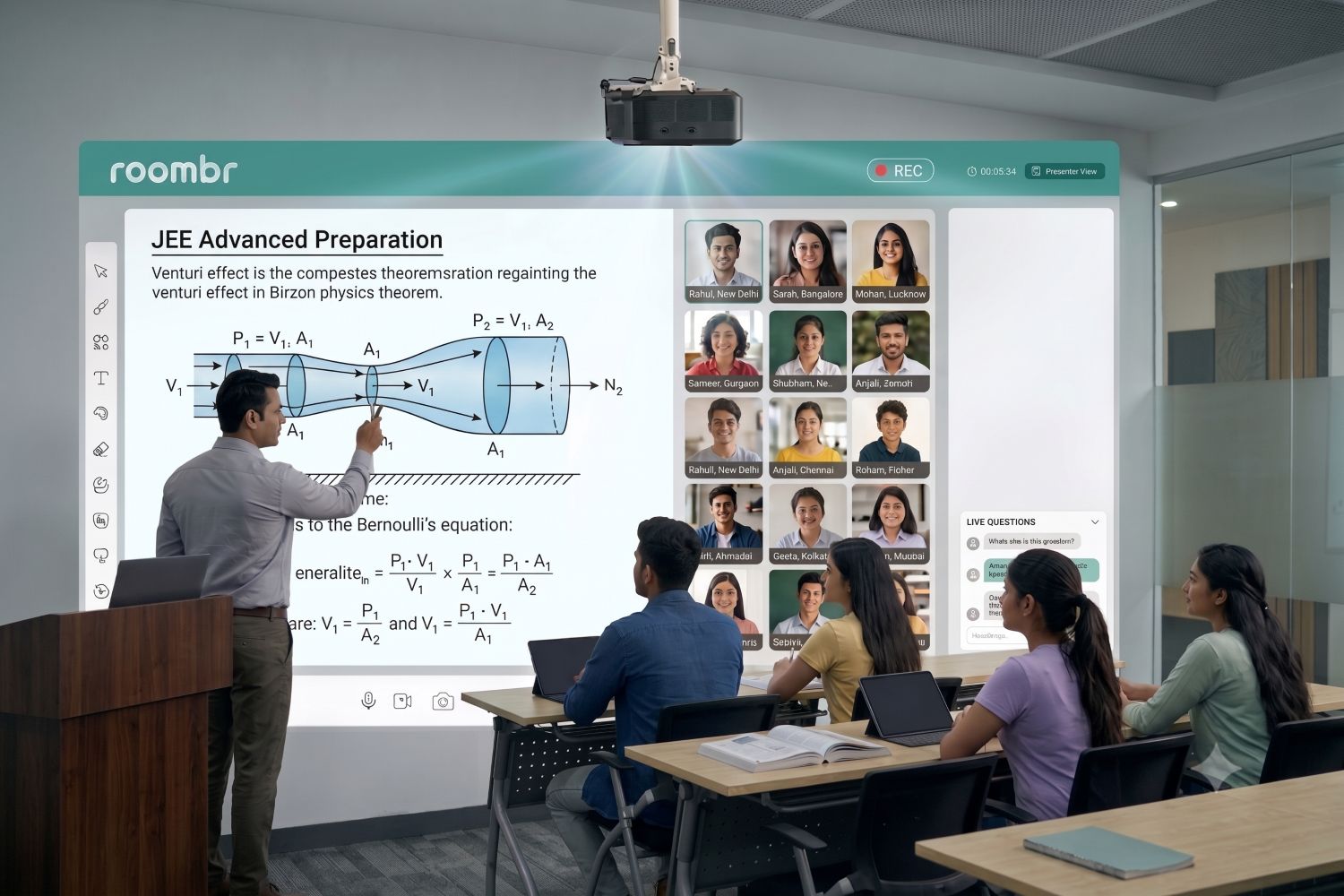
During the SAR phase, these advanced systems automatically generate attainment data. When a teacher uses the interactive walltop computer, the system logs the session details. During the teaching phase, a built-in lecture capture system records the audio, video, and digital board notes simultaneously.
This automated tracking effortlessly generates the evidence you need. When the auditors ask for proof of remedial teaching or innovative pedagogy, you simply pull up the geotagged digital logs. During the PTV phase, walking evaluators into a sleek, cable-free classroom proves your commitment to Tier-1 infrastructure.
Plan a Realistic Timeline for Your Peer Team Visit
Institutions that succeed at NBA accreditation never rush the process. A realistic preparation cycle spans anywhere from 6 to 12 months before you even submit the pre-qualifiers.
You need months just to gather historical data and align your current faculty with the OBE framework. The SAR development phase alone requires extensive cross-departmental auditing. Rushing this specific phase almost always leads to data inconsistencies. When evaluators spot rushed data, they assume the institution is hiding academic flaws, which inevitably leads to a poor grade or an outright rejection.
The Ultimate Pre-Visit Checklist to Impress Evaluators
Use this actionable checklist in the final weeks leading up to your on-site audit to ensure your campus is flawlessly prepared.
- Academic Readiness: Ensure your CO-PO mapping is 100% finalized and printed. Validate all internal assessment data and ensure it matches the submitted SAR exactly.
- Infrastructure Health: Verify that all engineering labs are highly functional with updated safety protocols. Test all digital displays and ensure your campus Wi-Fi can handle peak loads during the evaluator walkthrough.
- Faculty Preparation: Run mock interviews. Ensure every professor is prepped for live pedagogical demonstrations and can articulate how their specific subject meets the program outcomes.
- Documentation Accessibility: Organize all digital and physical evidence. Create clear folders for student feedback forms, placement records, and infrastructure maintenance logs so you can hand them to auditors instantly upon request.
Move Beyond Compliance Toward Continuous Improvement
Securing NBA accreditation is an incredible milestone, but it is not the finish line. The Washington Accord framework is designed to push engineering colleges toward a state of constant evolution. Treat this process as a continuous growth framework rather than a one-time administrative chore to check off a list.
Institutional leaders must encourage their departments to transition from mere document creators to genuinely outcome-driven educators. Stop relying on manual ledgers and exhausting end-of-year data entry. Build automated digital systems that silently collect your compliance data every single day. By investing in the right digital infrastructure and fostering a data-first culture, you permanently eliminate audit anxiety and secure the long-term legacy of your institution.
Frequently Asked Questions
1. What is the difference between Tier-I and Tier-II NBA accreditation?
Tier-I is strictly for autonomous institutions, offering more curriculum flexibility. Tier-II is for non-autonomous colleges affiliated with a university. Both rigorously evaluate outcome-based education.
2. How does faculty turnover impact our SAR submission?
Frequent teacher turnover is a warning sign that erases valuable teaching records. Utilizing a digital classroom ecosystem archives teaching materials and assessment data, protecting your institution even when professors leave.
3. Can we apply for the NBA if we lack NAAC accreditation?
Yes. NAAC evaluates the entire campus, while NBA assesses individual technical programs. Accrediting flagship programs first can quickly boost your enrollments and government funding.
4. What do peer evaluators ask students during their visit?
Assessors bypass the faculty to ask students if they understand their specific Course Outcomes. They also verify if the smart classroom equipment mentioned in your report is accessible daily.
5. Is there a waiting period if our program faces rejection?
Yes. If your application is rejected during the initial expert review due to poor data, that specific program must wait one full academic year before submitting a fresh e-NBA application.
6. How quickly do colleges see ROI after upgrading technology?
Returns typically appear by the next admission cycle. Accredited programs can petition for higher tuition fees, while tech-enabled classrooms instantly attract premium student enrollments and top-tier corporate recruiters.
Make Your Infrastructure Do the Heavy Lifting for NBA Compliance
The moment evaluators step into your engineering blocks, physical paperwork loses its power. They expect to see dynamic teaching, engaged students, and immediate, verifiable data proving your educational outcomes.
Roombr is engineered specifically to handle this modern reality. We replace cluttered projector setups and basic panels with a patented, all-in-one advanced digital classroom experience. But the true value for your leadership team lies in what happens in the background. As your faculty delivers complex engineering concepts on a massive interactive wall, Roombr silently logs the session, captures the lecture, and generates the attainment evidence your Self Assessment Report demands.
You permanently eliminate the anxiety of lost physical ledgers or undocumented remedial classes. Transition your campus from simply checking compliance boxes to demonstrating Tier-1 technological excellence.
Book a customized campus demo to see how Roombr secures your next accreditation cycle.

Foziya Abuwala
Share
Step Into the future of
Education with Roombr