


Roombr vs Interactive Flat Panels for B.Tech Smart Classes
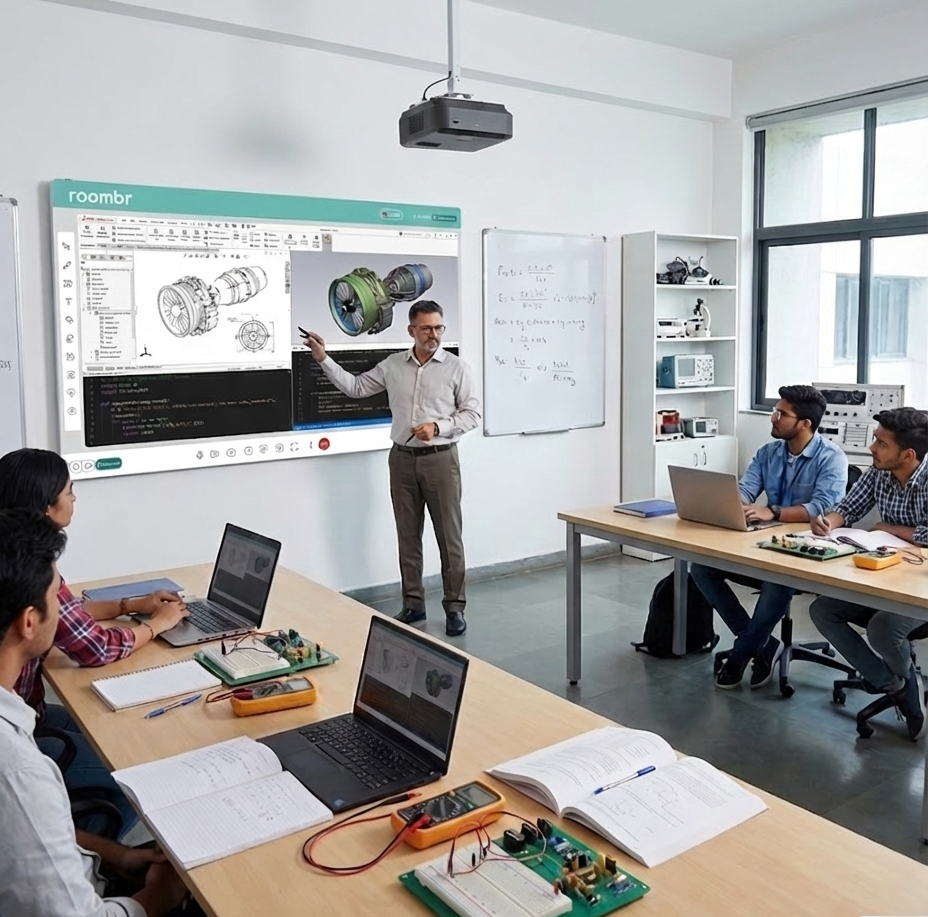
Engineering education in India is undergoing a significant digital transformation. With the National Board of Accreditation (NBA) and NAAC placing heavy emphasis on ICT-enabled pedagogy, most institutions are rushing to modernize. However, choosing the right hardware for a technical environment is different from a standard K-12 setup. While many colleges default to interactive flat panels or interactive boards, the specialized needs of an engineering curriculum often require more than just a large tablet on a wall. For HODs and Principals looking to build high-performance B.Tech smart classes, the choice between a standard display and a holistic solution like Roombr determines the long-term academic ROI.
The Visibility Gap in B.Tech Smart Classes
Most B.Tech classrooms in India are designed to accommodate 60 to 70 students. In this environment, the physical size of the display becomes a critical factor for learning. A standard 75-inch or 86-inch flat panel often fails to provide enough digital real estate for technical subjects.
Engineering professors frequently deal with circuit diagrams, complex fluid mechanics derivations, or multi-step mathematical proofs. On a standard smart class screen, these diagrams must be zoomed in and out constantly, breaking the flow of the lecture. Students sitting beyond the third row often struggle to see the subscripts in a chemical equation or the small text in a line of code. This leads to cognitive overload and reduced engagement.
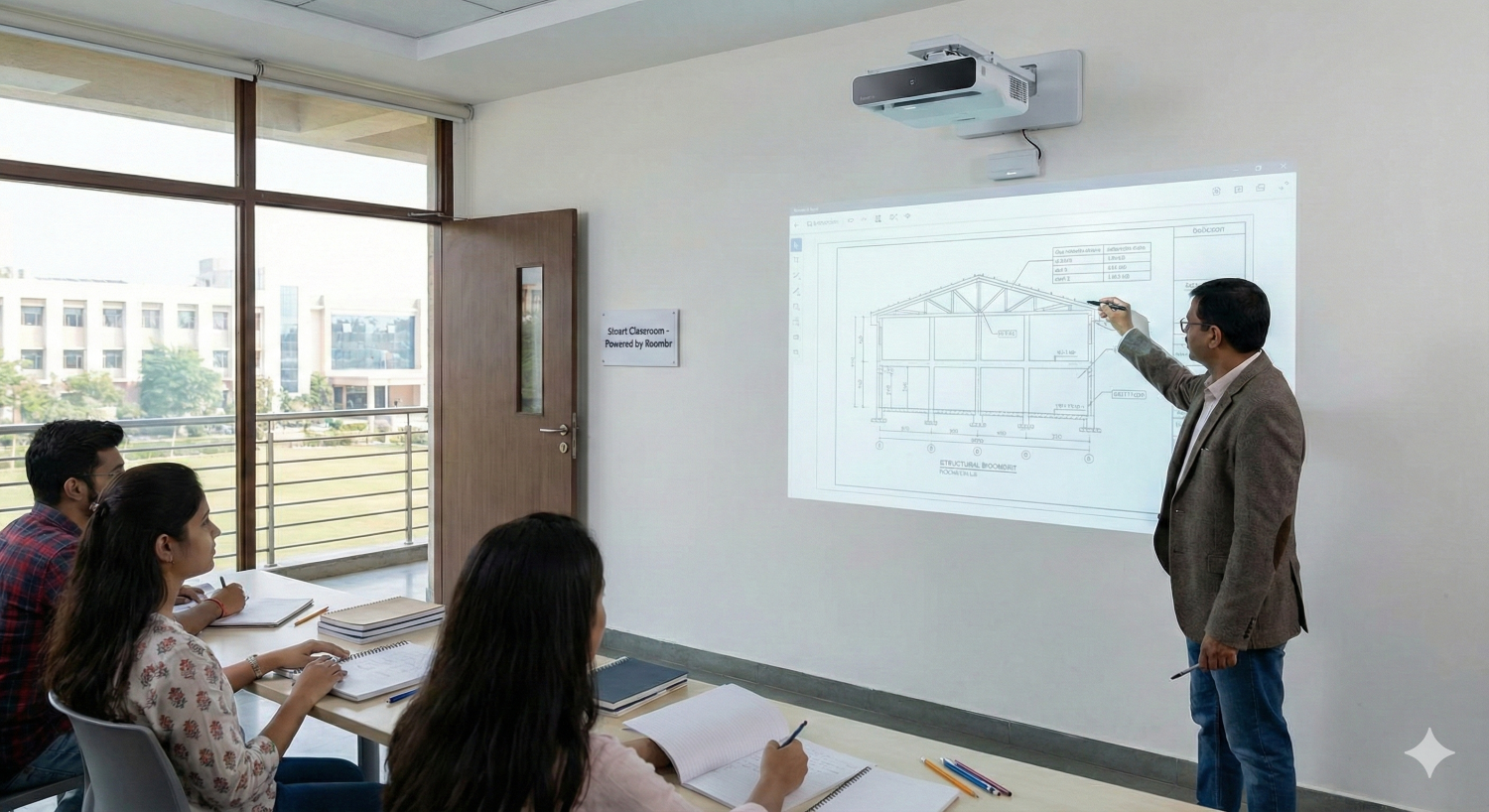
Roombr addresses this by offering a Walltop experience that converts the entire front wall into a 200-inch interactive canvas. In B.Tech smart classes, having this huge scale means a professor can keep the reference diagram on one side of the wall while solving the derivation on the other. This mirrors the traditional blackboard flow that engineering pedagogy has relied on for decades but adds the power of digital interactivity.
Why Roombr Outperforms Interactive Flat Panels in B.Tech Smart Classes
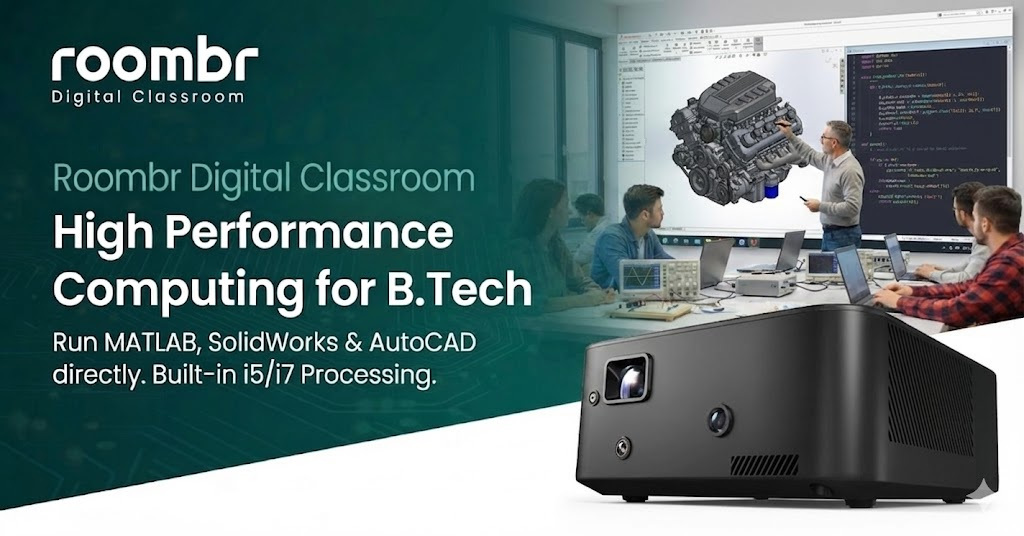
When comparing Roombr to traditional interactive panels, the differences in processing power and software integration become evident. Engineering students don't just look at slides; they interact with complex simulations and high-end software.
1. High Performance Computing for Engineering Simulations
Most interactive boards run on basic Android operating systems. While these are fine for playing videos or basic annotation, they struggle with heavy engineering files. Roombr features built-in Windows processing with i5 or i7 configurations. This allows a professor to run MATLAB, AutoCAD, or SolidWorks directly on the digital wall without any lag. For B.Tech smart classes, the ability to switch from a theoretical lecture to a live software simulation in seconds is a game-changer.
2. Intelligent Lesson Capture for Complex Revision
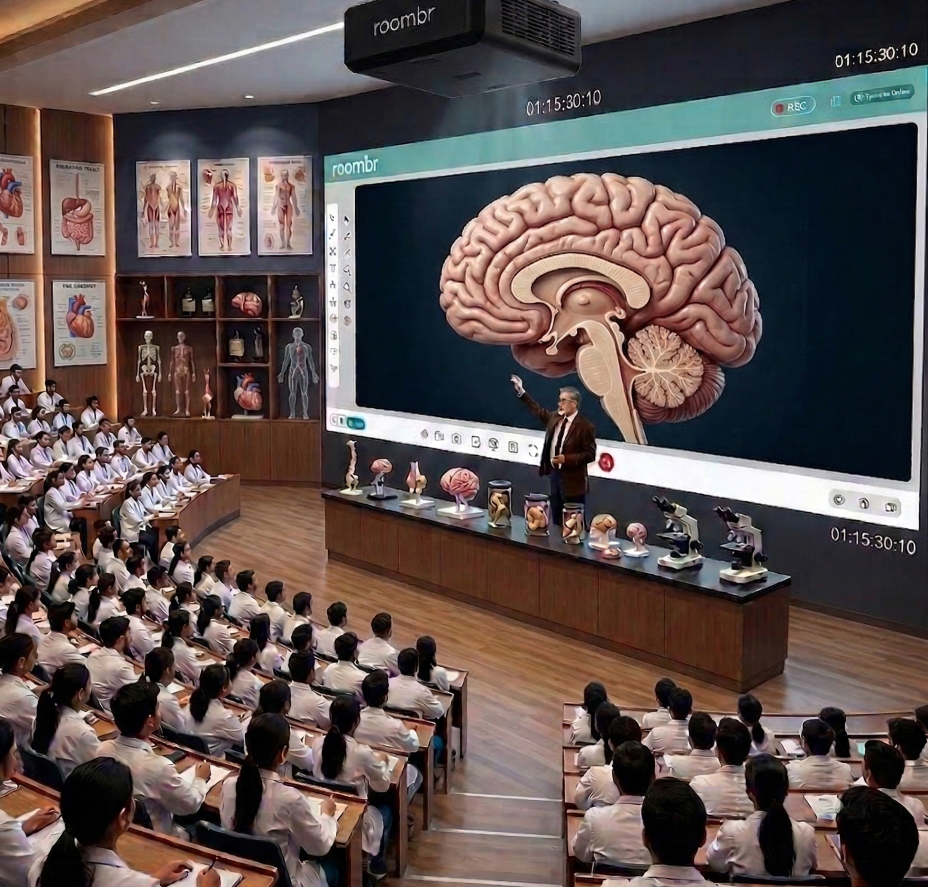
In a typical smart class, the value lies in the data. Engineering subjects are intellectually dense. Students often miss crucial logic while trying to copy down complex diagrams. Roombr solves this through automated, high-fidelity lesson capture. It records the entire session, including the professor's voice, the digital ink on the wall, and any software demos, and makes it available for student revision. Unlike the manual recording setups often used with interactive flat panels, this process is seamless and built-in.
3. Durability and Eye Comfort in High Usage Environments
Engineering colleges operate on rigorous schedules with back-to-back lectures from morning to evening. Large LED-based flat panels emit significant blue light, which can cause eye strain for both faculty and students over long durations. Roombr uses a projection-based Walltop technology that is much gentler on the eyes. Furthermore, the hardware design makes maintenance costs significantly lower in high-traffic college environments.
4. Direct Alignment with NBA and NAAC Accreditation
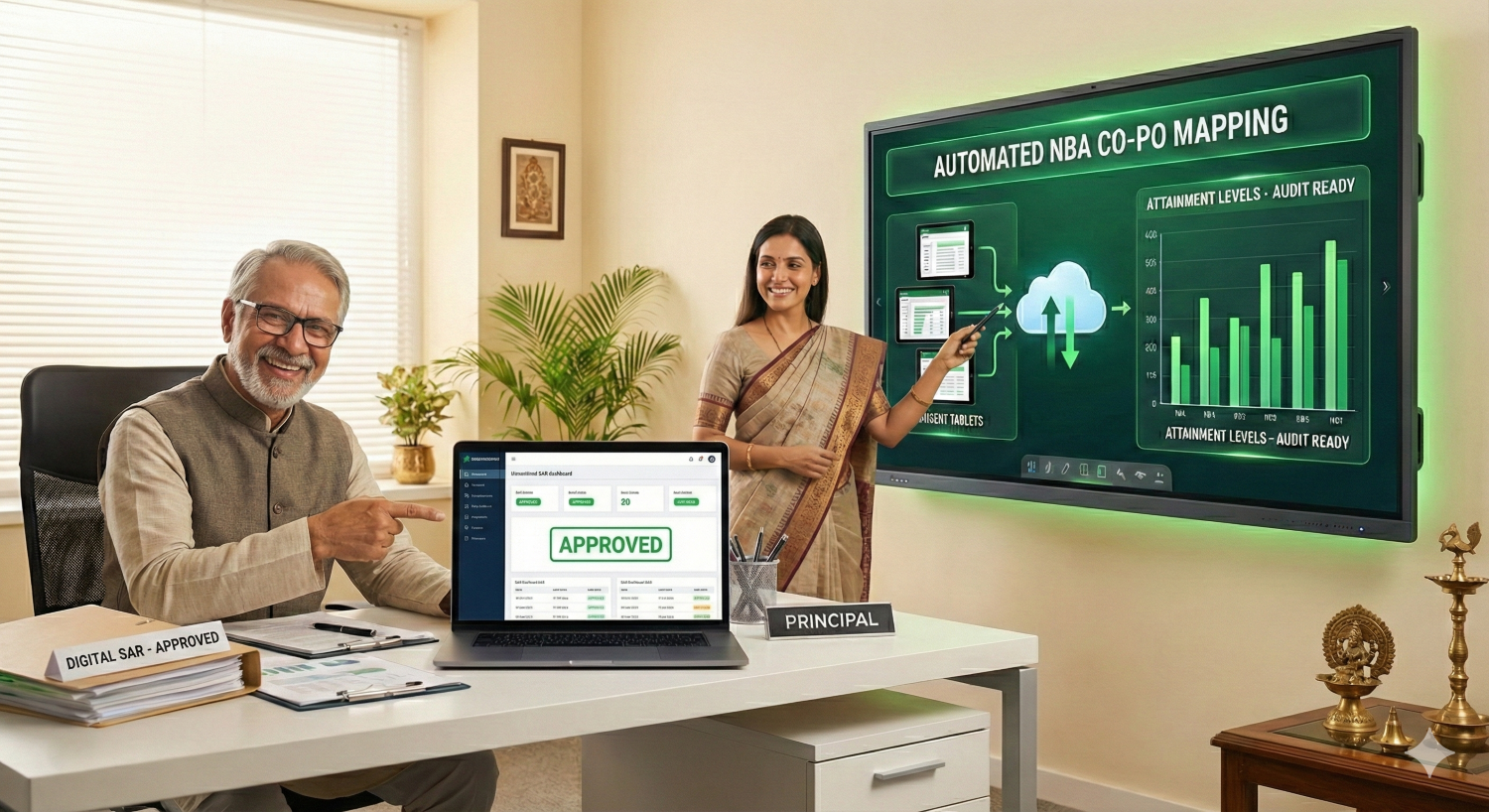
One of the biggest hurdles for B.Tech institutions is documenting ICT usage for accreditation. Roombr provides detailed analytics on how the technology is being used in B.Tech smart classes. This data acts as concrete evidence for NBA and NAAC committees, proving that the institution is not just buying hardware but actively improving the teaching-learning process. While interactive panels are often used as simple displays, Roombr functions as a comprehensive pedagogical tool.
Cost Effectiveness and Procurement via GeM
For government and private engineering colleges in India, procurement is a major consideration. While the initial sticker price of a high-end panel might seem lower, the Total Cost of Ownership (TCO) often tells a different story. Smart classes require longevity. Large glass panels are expensive to repair and consume significant electricity.
Roombr is a Make in India innovation and is listed on the Government e-Marketplace (GeM) under Multimedia Projector (MMP). This makes the procurement process for government-aided B.Tech institutions straightforward and compliant with L1 bidding norms. By choosing Roombr, institutions invest in a solution designed specifically for the Indian climatic and academic conditions.
Future Proofing Your Engineering Department
The shift toward B.Tech smart classes is no longer optional. However, the quality of that shift depends on whether the technology supports the curriculum or hinders it. Engineering is a visual and computational discipline. It requires space, speed, and the ability to revisit complex logic.
While interactive boards or panels have their place in smaller meeting rooms, they often fall short of the rigorous demands of a technical classroom. Roombr provides the scale of a traditional lecture hall with the computing power of a modern lab. For any institution aiming to produce industry-ready engineers, the choice is clear.
Summary of Differences for B.Tech Institutions
Experience the Future of B.Tech Education with Roombr Digital Classroom
Stop compromising on technical pedagogy with undersized screens and limited computing power. Equip your faculty with Roombr’s interactive digital canvas to boost student engagement, effectively visualize complex engineering derivations, and effortlessly meet strict NBA accreditation standards.
Are you ready to transform your engineering institution? Our team is prepared to offer a personalized walkthrough focused on your unique B.Tech syllabus needs. Simply submit this brief form to schedule your session. You can also connect with us directly at +91 9686659444 or via email at learn@roombr.com with any questions. We look forward to supporting your digital transformation.

Foziya Abuwala
Share
Step Into the future of
Education with Roombr


.png)


