

Managing a higher ed classroom involves much more than just delivering lessons. Lecturers juggle a wide range of tasks, and among the most time-consuming and repetitive is handling attendance and reporting. Traditionally, this means roll calls, paperwork, and manually compiling student data. These administrative tasks take valuable time away from teaching and can sometimes introduce errors, making it harder to track progress accurately.
With the rise of smart classroom solutions, higher education institutions, in particular, now have access to technologies that can streamline these administrative processes, making them faster and more accurate. This blog explores how automated attendance and reporting systems are transforming classroom management in higher education.
Time-Consuming Administrative Tasks in Education
We often talk about "teacher burnout" as a vague concept, but usually, it’s the result of a thousand small burdens. Manual attendance and reporting are major contributors to administrative overhead.
The Attendance Anchor
Think about the math. If a teacher spends 8 minutes per class on attendance and settling administrative tasks, and they teach five classes a day, that is 40 minutes daily. That’s over three hours a week. Over the course of a standard college year, a single teacher loses nearly three weeks of instructional time simply by checking boxes.
When you multiply that across an entire faculty, the inefficiency is staggering. And that’s assuming the manual data is accurate.
The "Proxy" and Accuracy Problem
In a traditional or even a basic digital classroom setup, accuracy can be a significant headache. Paper sheets get lost. Students sometimes shout "present" for their absent friends. In hybrid setups, tracking who logged in and for how long is a logistical nightmare.
This leads to "inefficient data." When administrators pull reports at the end of the term, they are often looking at numbers that don't reflect reality. This impacts everything from funding (which is often tied to attendance metrics) to student intervention strategies. You can’t help a student who is falling behind if your data says they were in class when they weren’t.
The Smart Classroom Fix: Automated Attendance and Reporting

This is where the problem meets the solution with smart classroom equipment. The new standard isn't just about display. It's about workflow.
Automated attendance systems replace the manual "call and response" with passive or active digital verification. This technology integrates directly into the classroom infrastructure, syncing with the college or university’s Management Information System (MIS) or Learning Management System (LMS) in real-time.
How It Works in the Real World
Imagine a university lecturer walking into a packed lecture hall and immediately diving into their material. There is no roll call. Instead, the attendance is handled in the background.
Different higher education institutions use different methods, RFID badges or facial recognition are common, but the most versatile and reliable method emerging in the market is the mobile-integration approach. This is absolutely vital in higher education, where BYOD (Bring Your Own Device) is standard, and large class sizes make traditional methods impractical.
The Roombr Smart Classroom Advantage: Bridging the Hybrid Gap
This is where specific technology choices matter. Many generic systems struggle with hybrid learning. They can track the kids in the room, but not the ones at home.
Roombr has tackled this specifically with a unique QR-based system.
Here is how it works: A unique QR code is generated on the smart classroom display.
- For students in the room: They scan it with their device. This action instantly logs their attendance.
- For students joining online: The Roombr application automatically ticks their attendance when they join the classroom online.
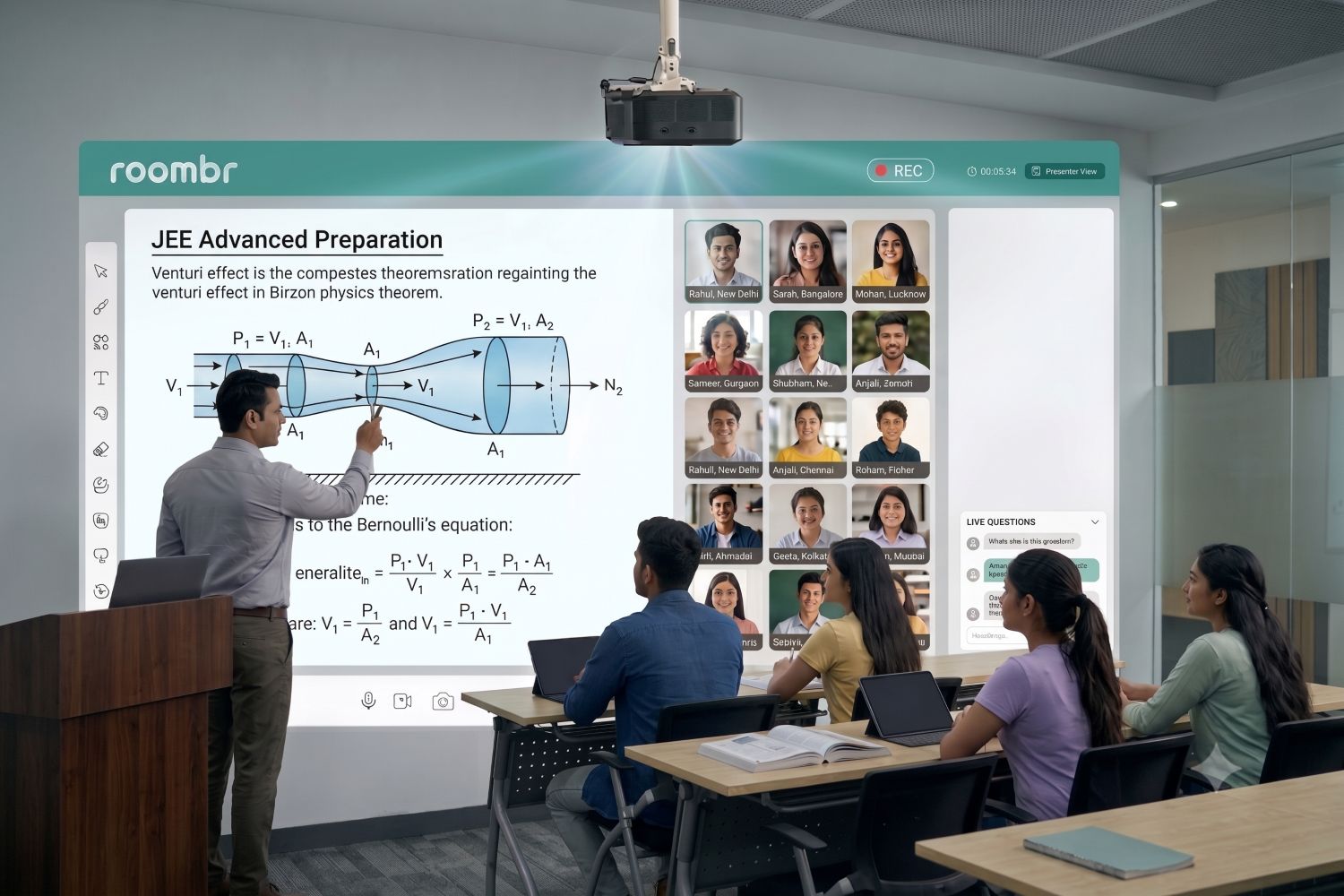
This allows students to attend classes online and be marked present instantly, using the same verification method as the students in the physical seats. It unifies the data. The professor doesn’t have to maintain two separate lists; the system just knows who is there, regardless of their physical location.
Benefits of Automated Attendance and Reporting Systems
Why should a university board or IT director sign off on this investment? Because the ROI extends beyond just "saving time."
1. Data Integrity and Compliance
For administrators, accurate reporting is gold. Automated systems remove human error. You get a timestamped, verified record of attendance. If a parent asks, "Was my child in physics on Tuesday?" you don't have to hunt through a binder. You have a digital log.
This level of accuracy is crucial for regulatory compliance and state reporting, ensuring the institution’s records are audit-proof.
2. Instant Feedback Loops
In a manual system, reporting is a lagging indicator. You might not realize a student has missed 10 days of math until the end-of-term report is compiled.
With a fully integrated digital classroom setup, reporting is real-time. Administrators can set triggers: If a student misses three consecutive classes, send an alert to the guidance counselor. This shifts the college’s posture from reactive to proactive.
3. Reducing the IT Burden
It sounds counterintuitive, adding more tech to reduce IT burden. However, legacy systems require constant manual patching of data. IT administrators often spend time fixing database errors caused by manual entry.
Modern smart classroom solutions are cloud-native. They update automatically, sync without manual uploads, and provide a "single source of truth."
Overcoming Implementation Challenges
If you are an IT Administrator reading this, you are probably thinking about the headache of integration. That is valid. Here is how to smooth out the transition.
Compatibility is King
Avoid buying a standalone attendance tool. Ensure your attendance automation is part of your broader hardware/software ecosystem. The Roombr Digital Classroom system works well because the attendance feature is native to the computing unit that runs the classroom. It’s not an add-on; it’s built-in.
Security and Privacy
Biometrics (facial recognition) can be a privacy minefield in colleges and universities. This is why the QR/Device-based approach is often preferred. It verifies the credentials and the location without storing sensitive biometric data of minors. Always vet your vendors on where the data is stored and ensure it is encrypted in transit.
The "Culture" Shift
The biggest hurdle won't be the software; it will be the people. Educators may express concern that automation could lead to a perception of increased surveillance.
- The Messaging Matters: Frame this as a tool to give them their time back, not a tool to monitor them.
- The Student's Responsibility: It shifts the onus of attendance to the student. If they don't scan, they aren't there. This teaches accountability, a soft skill valuable for university and the workforce.
The Verdict
We are past the point where "smart" just means "connected to the internet."
A true smart classroom respects the time of the people inside it. It acknowledges that a teacher’s value lies in their ability to explain complex concepts and mentor students, not in their ability to fill out a spreadsheet.
By adopting automated attendance and reporting, specifically versatile systems like Roombr’s QR integration, you aren't just upgrading your technology. You are upgrading your institution's culture. You are telling your staff that you value their time enough to stop wasting it.
Automate Attendance & Reclaim Teaching Time with Roombr
Your university's faculty members are here to inspire, research, and educate. Roombr helps educators transform attendance from a manual burden into a seamless, intelligent process. With our unique QR-based attendance, students can mark their presence instantly, whether in your lecture hall or engaging remotely. This means no more roll calls, no proxy issues, and perfectly synchronized, real-time data for academic advisors and administrators. Empower your faculty to focus on impactful teaching and research.
Schedule a higher ed digital classroom demo to see how Roombr automates attendance across your campus today.

Foziya Abuwala
Share
Step Into the future of
Education with Roombr